The room you didn't write for

The champion loved the demo. The shortlist had two names on it, and yours was the one they forwarded to their boss. Marketing logged it as a deal about to close. Six weeks later it is still "in progress", and nobody on your side can say what is happening inside the buyer's building.
Most content plans stop at that moment. Persona, funnel stage, campaign: the calendar is built around the person who finds you and picks you. That person has done their job. The deal now sits with people who never saw your webinar. Who they are is the interesting part, and the data puts them somewhere most plans never look.
The shortlist says less than we think
G2's 2026 Buyer Behavior Report, published on 22 July, surveyed 1,038 B2B software decision-makers in June 2026. Evaluation is now the longest stage of the buying journey, 40% of it, ahead of research at 36%. AI chatbots and review sites get buyers to a shortlist faster. The friction has moved to what comes after.
The 6sense research team sees something similar from the other side. Writing on 21 September about buying journeys that end in no decision, they said those journeys look remarkably like the ones that end in a purchase: a similar number of vendors on the shortlist from day one and a similar size of buying group. The full report is due in November, so for now this is a teaser without numbers. One difference they did name is the case for the category itself, where vendors "do relatively little to help".
A strong shortlist position, then, tells you little about whether the deal closes. The rooms after it decide that.
The rooms after the shortlist
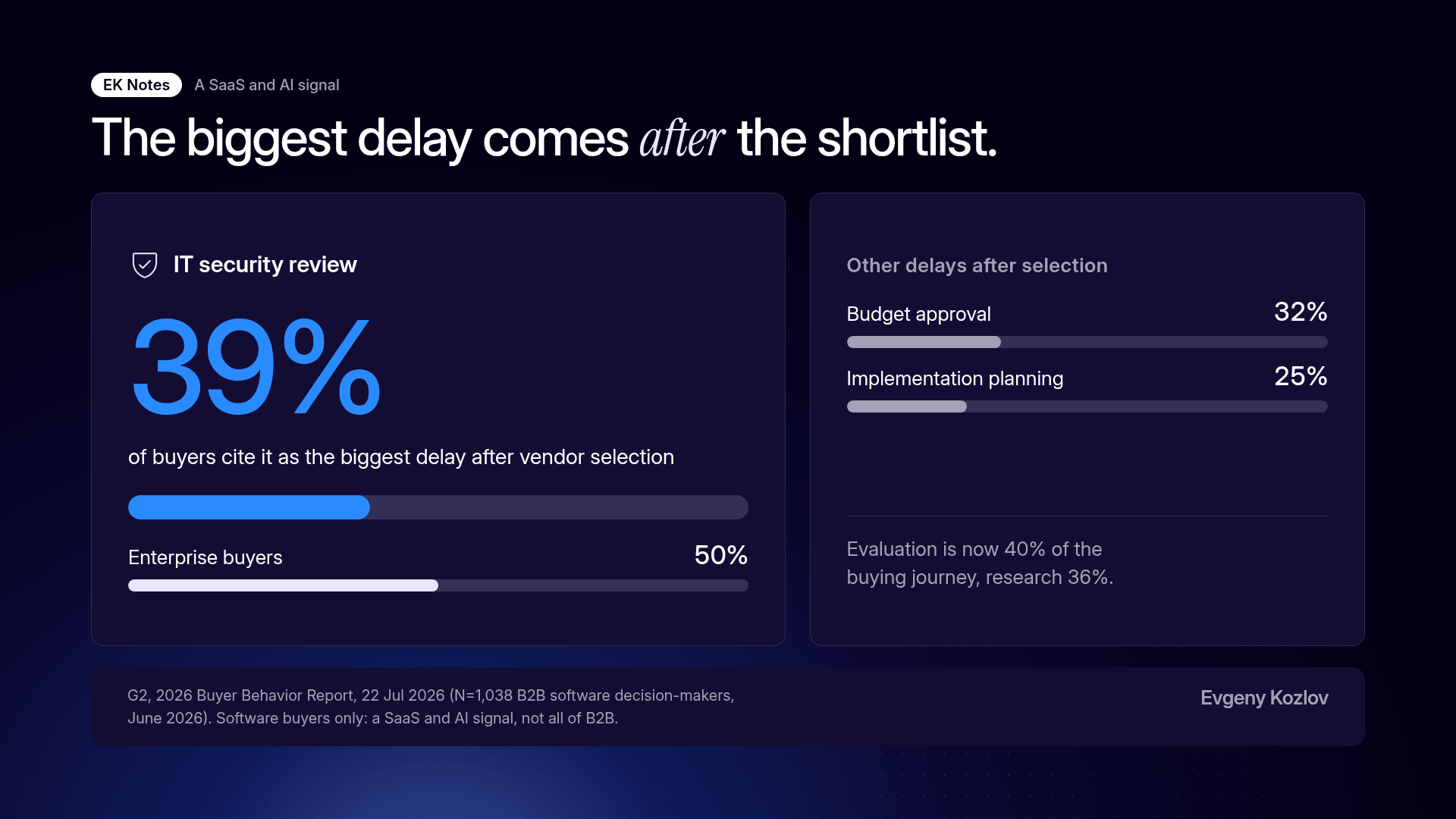
G2 names them. The single biggest source of delay after a vendor is selected is the IT security review, cited by 39% of buyers and by 50% of enterprise buyers. Budget approval follows at 32% and implementation planning at 25%. Finance involvement in software decisions rose from 31% to 46% in a year, and 49% of buyers say their CFO vetoed an already approved software purchase in the last 12 months. The share of buyers worried about internal resistance to AI adoption went from 16% to 29%, the largest one-year shift in the study.
So the deal is waiting on the security reviewer, the finance approver and the colleague who does not want the AI tool at all. None of them is on the content calendar. Their questions get answered by a sales engineer filling in a questionnaire, by legal sending a PDF after the ask, or by the champion improvising in a meeting you are not in.
That is the habit to drop: a content plan mapped to one persona and three funnel stages, with everything after selection treated as sales admin.
Write for the reviewer
Content for the reviewer is pipeline content. It decides whether a deal that marketing already counted turns into revenue. I would start here:
- Pull the last ten deals that stalled or slipped after the shortlist and write down who stopped them and what they asked.
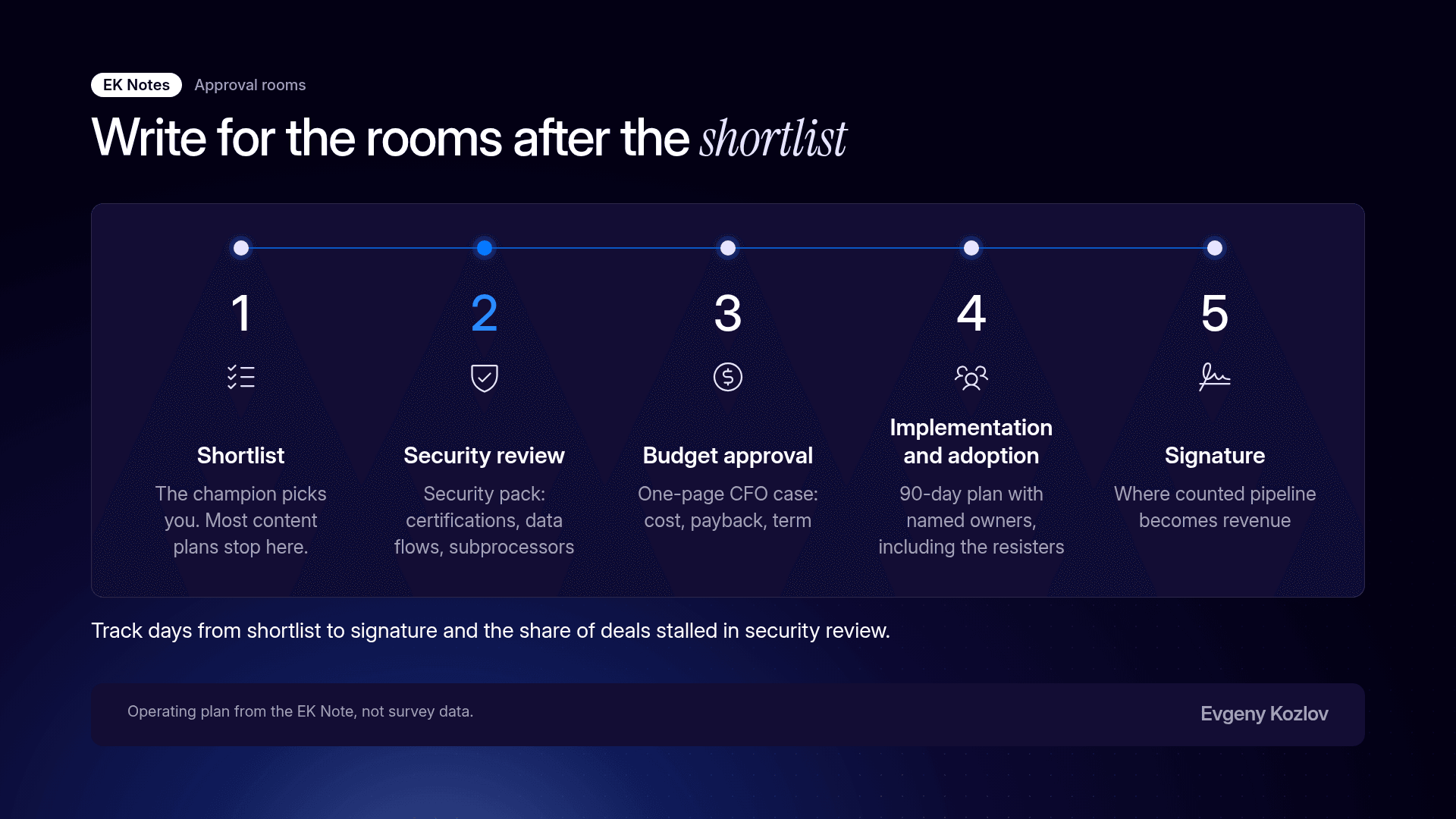
- Publish, ungated, the three documents those people need. A security pack: certifications, data flows, subprocessors and the answers to the questionnaire you get every time. A one-page case for the CFO in their terms: cost, payback period, contract length and what happens to spend if usage grows. An implementation plan that names who does what in the first 90 days, including the people who will resist.
- Track two numbers next to pipeline: days from shortlist to signature, and the share of deals that stall in security review.
G2 also shows how to write the CFO page. Among buyers who saw an approved deal vetoed, three in four expect positive ROI within six months of signing, and 40% push for contracts shorter than 12 months, against 18% of buyers who have not been through a late veto. A finance page that skips payback and term length is written for the wrong room.
For the colleague who resists, the 6sense point applies. The champion needs help defending the category, not only your product. A page that explains why this kind of tool deserves budget at all is one most vendors never write.
From one champion to every approver
Operating argument from the EK Note, not survey data.
Before: content for one champion
- One persona
- Three funnel stages
- Security answers by sales engineers
- PDFs from legal after the ask
- Champion improvises
After: content for every approver
- Security pack, ungated
- CFO page with payback and term
- Implementation plan with named owners
- Category case for the resister
- Shortlist-to-signature days tracked

What is confirmed and what is not
Confirmed: the G2 figures above, re-read in G2's press release on 22 October 2026, and the 6sense quote, re-read on its RevCity post the same day. G2 sells to software vendors and surveyed software buyers only, so read it as a signal for SaaS and AI tools, not all of B2B. The 6sense point stays qualitative until the full report lands.
Plausible, not proven: that publishing reviewer content shortens the stage after selection. I found no public data that measures it. The test is cheap. Ship the three documents, then compare shortlist-to-signature days for the next quarter with your last ten deals.
The brake: in small deals with one decision-maker there is no security room, and the CFO is often the buyer. The rule starts to matter from mid-market up, and in regulated buyers such as banks and insurers.
If your content stops at the shortlist, you are writing for the person who already said yes and leaving the people who can still say no to improvise.
Sources
- G2, "AI Is Making Software Easier to Find and Harder to Buy, According to New G2 Research" (G2 2026 Buyer Behavior Report: The Evaluation Maze), PR Newswire, 22 Jul 2026, re-read 22 Oct 2026 (online survey of 1,038 B2B software decision-makers, June 2026; evaluation 40% vs research 36%; IT security review 39%, 50% enterprise; budget approval 32%; implementation planning 25%; internal resistance to AI 16% → 29%; finance involvement 31% → 46%; CFO veto of approved purchase 49%; after a veto, three in four expect positive ROI within six months and 40% vs 18% push for terms under 12 months.)
- 6sense research team (saraboostani), "We've Spent Years Studying Buyers Who Purchase. This Year We Studied the Ones Who Didn't.", RevCity by 6sense, 21 Sep 2026, re-read 22 Oct 2026 (no-decision journeys similar on shortlist size and buying-group size; category justification hurdle; providers "do relatively little to help"; full results "early November". Qualitative, no numbers.)
Related notes
- Hybrid pricing needs a worked example, not a credit tableIf buyers can't predict the bill, the deal stalls. Hybrid pricing is becoming the default, and its weak point is the explanation, not the maths. Marketing should own that explanation before the 2027 price change ships.
- AI shortlists drop vendors whose claims can't be verifiedThe claim nobody can check costs you the deal. AI builds the shortlist, but a vendor stays on it only when a stranger can confirm the claim. Before 2027 campaigns launch, give every top claim a named proof or cut it.
- Influenced is not ownedPipeline influenced is now marketing's favourite headline number because every team can claim it. Before the 2027 plan locks, give every number one owner.