AI shortlists drop vendors whose claims can't be verified
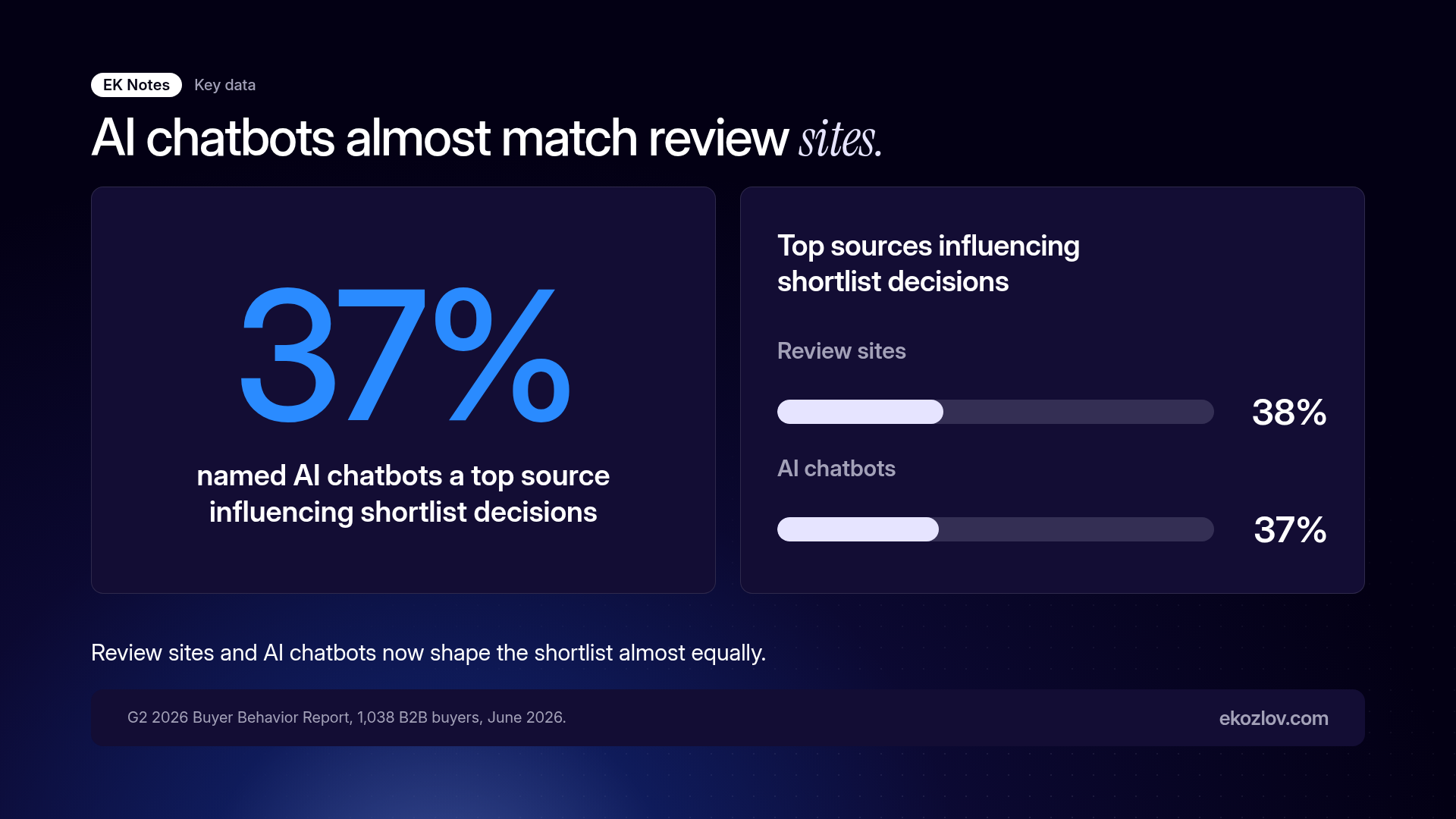
AI now builds the first shortlist. In G2's 2026 Buyer Behavior Report (1,038 B2B buyers surveyed in June 2026), the two top sources influencing shortlist decisions were review sites at 38% and AI chatbots at 37%. Bain published a survey on 23 October under a blunt headline: most software buyers use AI to find vendors.
So the machine builds the list. What keeps a vendor on it is something else: a stranger who can confirm the claim.
The problem: claims with nothing behind them
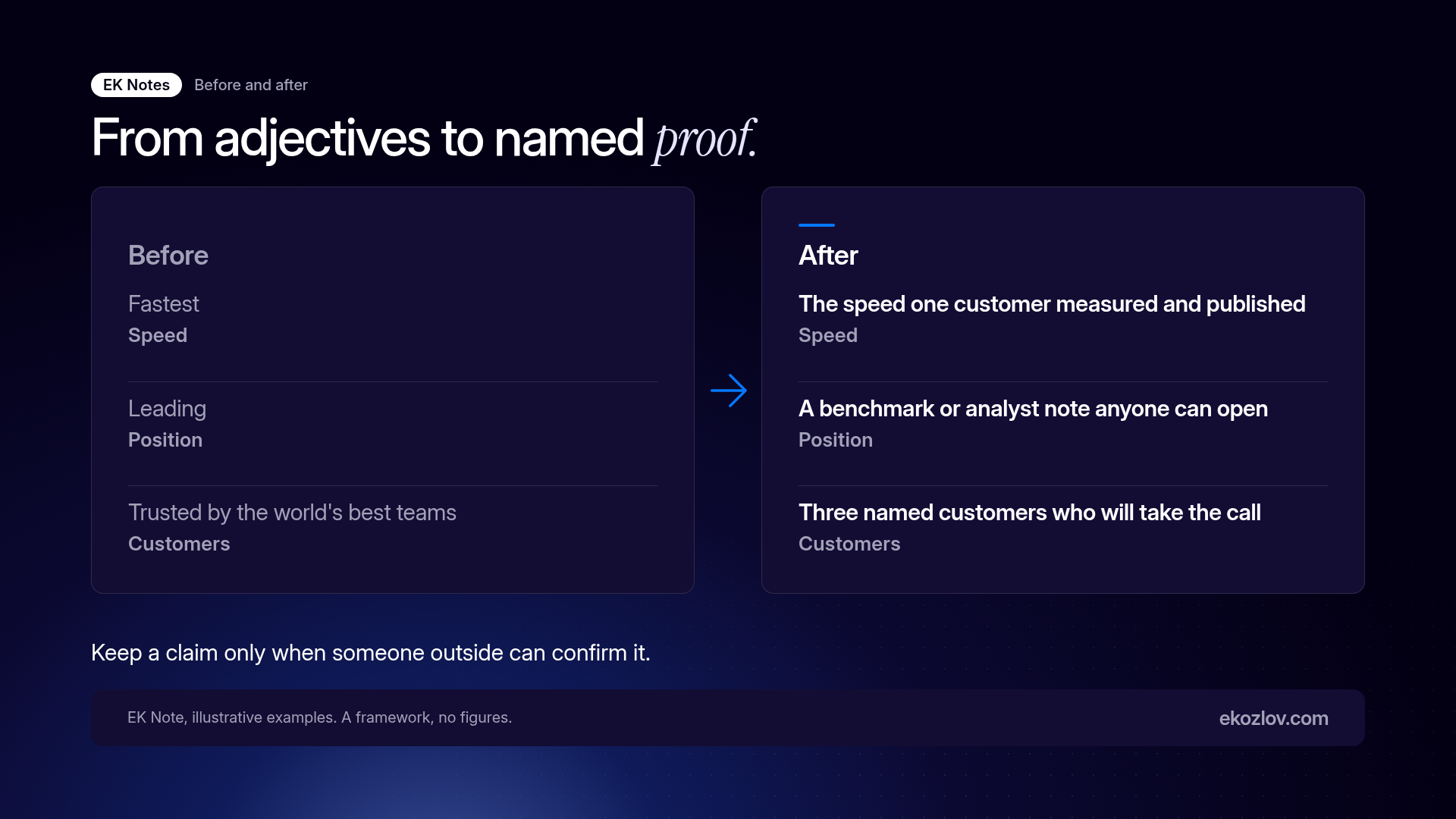
Look at almost any B2B homepage. "Fastest." "Leading." "Trusted by the world's best teams." Every one of these lines asks the buyer to take the vendor's word for it. For years that worked well enough, because a buyer had to read the page, book a call and then decide whom to believe.
That step is now done before the call. Forrester's 2027 B2B go-to-market predictions, published on 21 October, put it in two lines. These are forecasts, not measured results, but they describe the direction. First, two-thirds of providers will lose deals because buyers cannot verify their claims. Second, buyers will double their human interactions to validate AI-generated recommendations, talking to provider teams and to trusted third parties such as analysts, customer references and partners.
Read those two together. AI collects the claims, and then the buyer goes looking for someone outside the vendor who can back them up. A claim with no review, no reference and no public evidence behind it does not just fail to help. It costs you a place on the list.
G2's earlier AI Search Insight Report (1,076 buyers, March 2026) shows where that checking happens. 45% of buyers said a review-site citation is the most confidence-inspiring signal in an AI answer. When an answer surprised them, the most common reaction was to look for peer feedback.
I see the same split inside many marketing teams. The website and the deck belong to marketing. The review profiles sit with customer success as an afterthought, if anyone owns them at all. References are a favour sales asks for at the end of the deal. So the claims and the proof live in different departments, and nobody checks that they match.
The fix: one claim, one named proof
The fix is a short exercise, and it fits in one afternoon.
Take the top five claims on your homepage and in your main sales deck. For each one, write down who outside the company can confirm it. There are only three kinds of answer:
- A review. A real customer on a public review site who says the same thing in their own words.
- A reference. A named customer who will take a call and repeat the claim to a buyer.
- Public evidence. A benchmark, a case study with numbers, an analyst note or documentation that anyone can open.
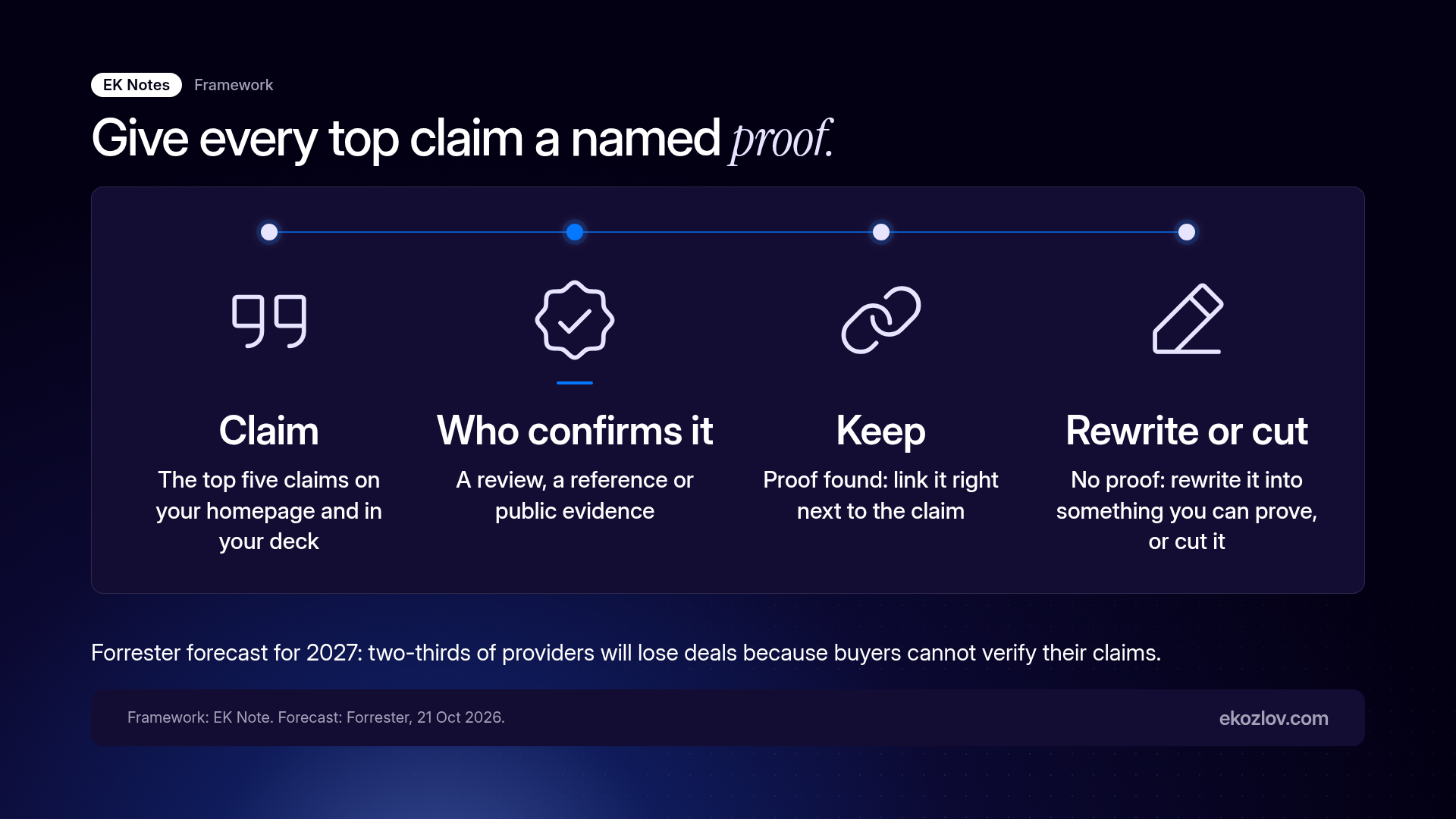
If a claim has one of these, keep it and link the proof as close to the claim as you can. If it has none, rewrite it into something you can prove, or cut it. "Fastest" becomes the specific speed one customer measured and published. "Trusted by" becomes three named customers who will actually pick up the phone.
Then fix the ownership. Someone in marketing should own the review profiles the same way they own the website, because for an AI answer they are the same surface. G2's own advice in its June report points the same way: build reviews around evaluation questions such as integrations, implementation speed and why a customer chose you over a named alternative, not just around star ratings.
Do this before 2027 campaigns launch. Every campaign built on an unprovable claim spends money to put that claim in front of a buyer who is about to check it.
The proof, and its limits
The proof here is mostly survey data, and it is worth reading carefully.
The G2 numbers are measured: 38% and 37% for shortlist influence, 45% for review citations. But G2 sells reviews, so it has every reason to find that reviews matter. The direction matches Forrester and Bain, which do not sell reviews, so I take the direction seriously and the exact percentages less so.
The Forrester two-thirds figure is a prediction for 2027. Nobody has counted those lost deals yet.
There is also a real brake on all of this. Reviews skew towards smaller companies and towards the loudest users. In a large enterprise deal, a star rating rarely closes anything. A named reference call with a peer at a similar company still beats it. That does not weaken the fix. It changes the mix: for SMB buyers the review profile does most of the work, for enterprise buyers the reference list does.
Either way, the rule is the same. In 2027 a claim with nobody behind it is not a message. It is a cost.
Sources
- Forrester, "2027 B2B Go-To-Market Predictions" press release, 21 October 2026 (forecasts)
- G2, 2026 Buyer Behavior Report (survey of 1,038 buyers, June 2026)
- G2, The Answer Economy: 2026 AI Search Insight Report (survey of 1,076 buyers, March 2026)
- Bain & Company, "Survey: Most Software Buyers Use AI to Find Vendors", 23 October 2026 (n=207, July 2026)
Related notes
- Your traffic chart now counts agentsThe 2026 traffic chart behind your 2027 targets now counts AI agents browsing for buyers. Split people from agents before the target locks.
- In production is not in useIn 2012 taxi apps topped every innovation ranking while 1.5% of Londoners had tried one. In 2026 "in production" plays the same role on AI slides. Judge 2027 AI lines on weekly users, checking hours and what breaks without them.
- Your AI SDR is a deliverability programAn outbound agent on a big list mostly spends your sender reputation. Replies come from small segments, checkable facts and a human edit.