Hybrid pricing needs a worked example, not a credit table

In February 2009 I opened my MegaFon account and added up what my phone had cost me. 9,090 roubles in 2006. 12,654 in 2007. 13,820 in 2008. About 1,100 a month, and I did not even talk much. My employer paid the bill, and I still wondered whether I could cut it. I was not sure I could. I wrote that phone spend had become part of the utilities.
That is exactly where B2B software buyers are heading now.
It looks like a finance decision
Pricing is changing fast. Stripe's survey of 200 SaaS platform leaders (published 19 October, fieldwork March 2026) found that 44% plan multiple pricing changes in the next 12 months. Seats as the primary model fall from 16% of platforms in 2026 to 11% in 2027. One in four plan to keep per-seat fees and charge separately for agent work in credits, usage or outcomes.
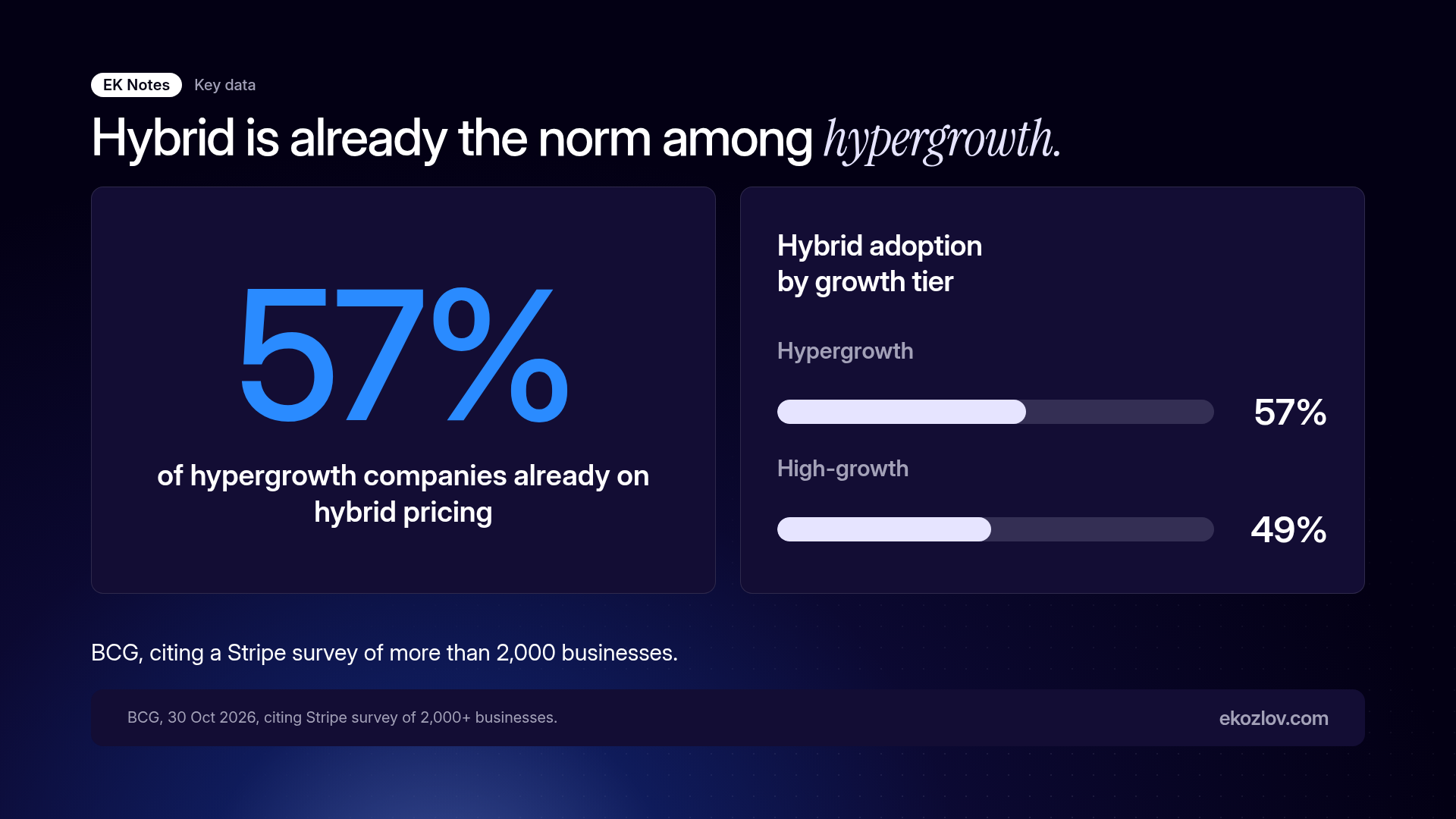
BCG, writing with Stripe and AWS on 30 October, calls hybrid the current leading approach: a subscription plus a usage, task or outcome element. Citing a Stripe survey of more than 2,000 businesses, it says 49% of high-growth and 57% of hypergrowth companies have already adopted hybrid models.
So far this reads like a job for finance and product. Pick the metric, build the metering, update the billing system. Most companies run it that way.
Then it shows up in the sales call
Here is the part that is not maths. Oliver Wyman surveyed more than 150 North American software buyers. Nearly two-thirds view usage-based pricing favourably and find it easier to understand. Roughly nine in ten are also worried about unpredictable costs. They like paying for what they use. They do not like a bill they cannot budget.
Oliver Wyman describes a vendor that launched an AI agent with a hybrid plan: the old subscription plus usage allowances. Customers struggled with abstract "compute units" and hesitated. The fix was not a new price. The vendor bundled usage into activities customers already understood, like data retrievals.
BCG makes the same point from the vendor side: an invoice the customer cannot understand erodes trust, and sales reps start improvising on price when price sheets and billing tools are disconnected.
That is a messaging failure. The unit of value, the words on the pricing page, the example a rep draws on the whiteboard. Those are marketing's job, and in most companies nobody in marketing is in the pricing room.
The fix: one sentence and one bill
Before your 2027 pricing change ships, do three things.
- Write one sentence that names what the customer pays for, in their words, not yours. "You pay per resolved ticket" works. "You pay per AI credit" does not, because nobody has a budget line called credits.
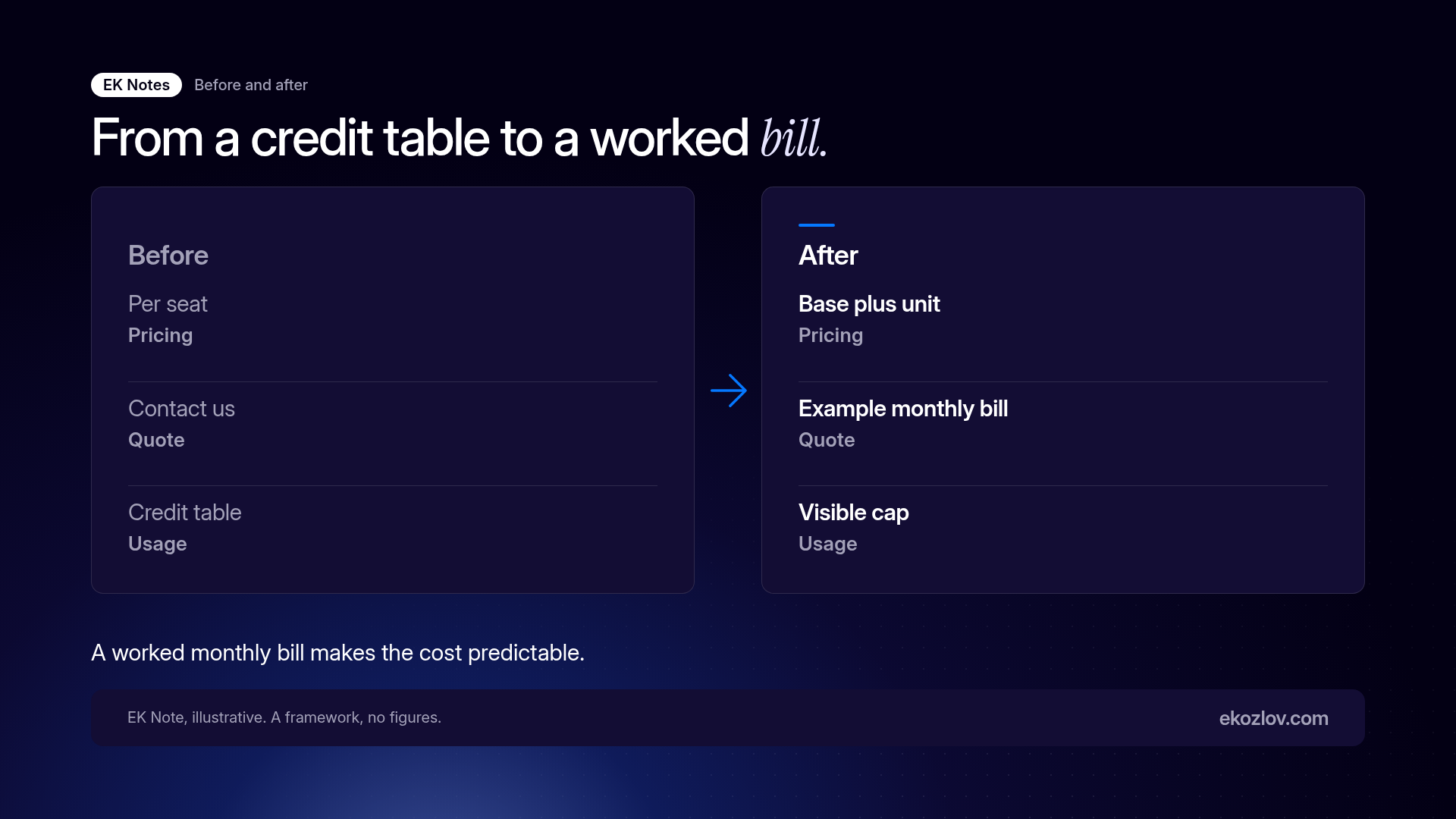
- Put a worked monthly example on the pricing page. A typical customer, their base fee, their usage, their total. Then a busy month. My 2009 self could have planned around that.
- Give sales the same example, with the same numbers. If the page and the rep tell different stories, the buyer trusts neither.
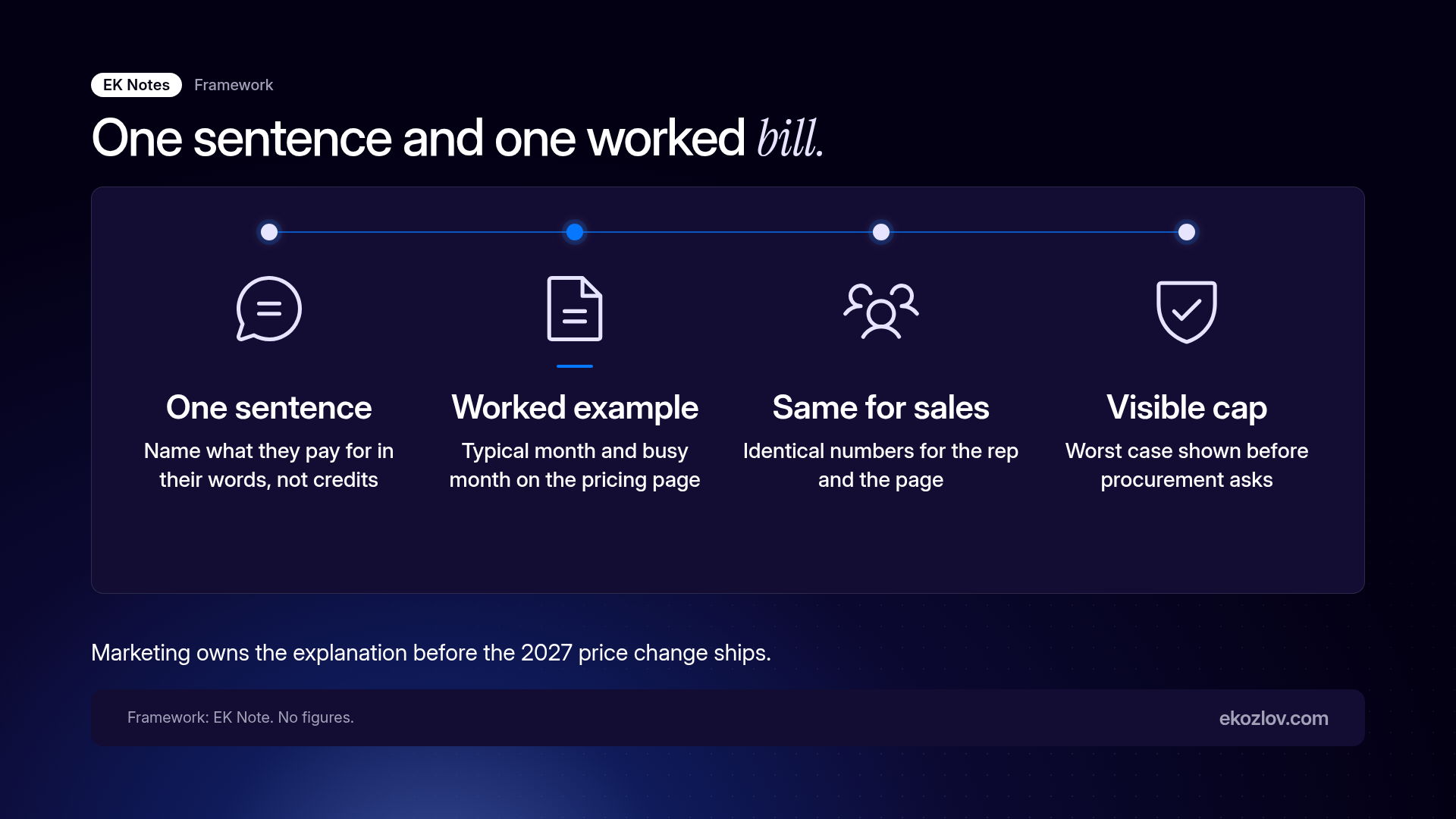
Then add a guardrail the buyer can see. Oliver Wyman's own list includes caps and true-ups for cost predictability. A cap shown on the page answers "what is the worst case" before procurement asks it.
Where this does not apply
Hybrid is not automatically better. For small deals a simple flat fee is often the stronger message, and Oliver Wyman notes that appetite for usage pricing is weakest in fixed-budget sectors such as healthcare and education. Also read the sources with care: Stripe sells billing, and these samples are mostly software companies.
But if your price is moving to base plus usage, the buyer's first question will not be "is this fair". It will be "what will this cost us". If the page cannot answer that, the deal waits.
Sources
- BCG, "As AI Reshapes SaaS, Companies Need Pivot-Ready Pricing", 30 October 2026
- Stripe, "Four trends reshaping how SaaS platforms compete in the AI era", 19 October 2026 (200 leaders, March 2026)
- Oliver Wyman, "Managing the AI pricing transition: seats versus usage", October 2026 (150+ North American buyers)
- Evgeny Kozlov, "Price of connection", 4 February 2009
Related notes
- AI shortlists drop vendors whose claims can't be verifiedThe claim nobody can check costs you the deal. AI builds the shortlist, but a vendor stays on it only when a stranger can confirm the claim. Before 2027 campaigns launch, give every top claim a named proof or cut it.
- Influenced is not ownedPipeline influenced is now marketing's favourite headline number because every team can claim it. Before the 2027 plan locks, give every number one owner.
- Your traffic chart now counts agentsThe 2026 traffic chart behind your 2027 targets now counts AI agents browsing for buyers. Split people from agents before the target locks.