Influenced is not owned

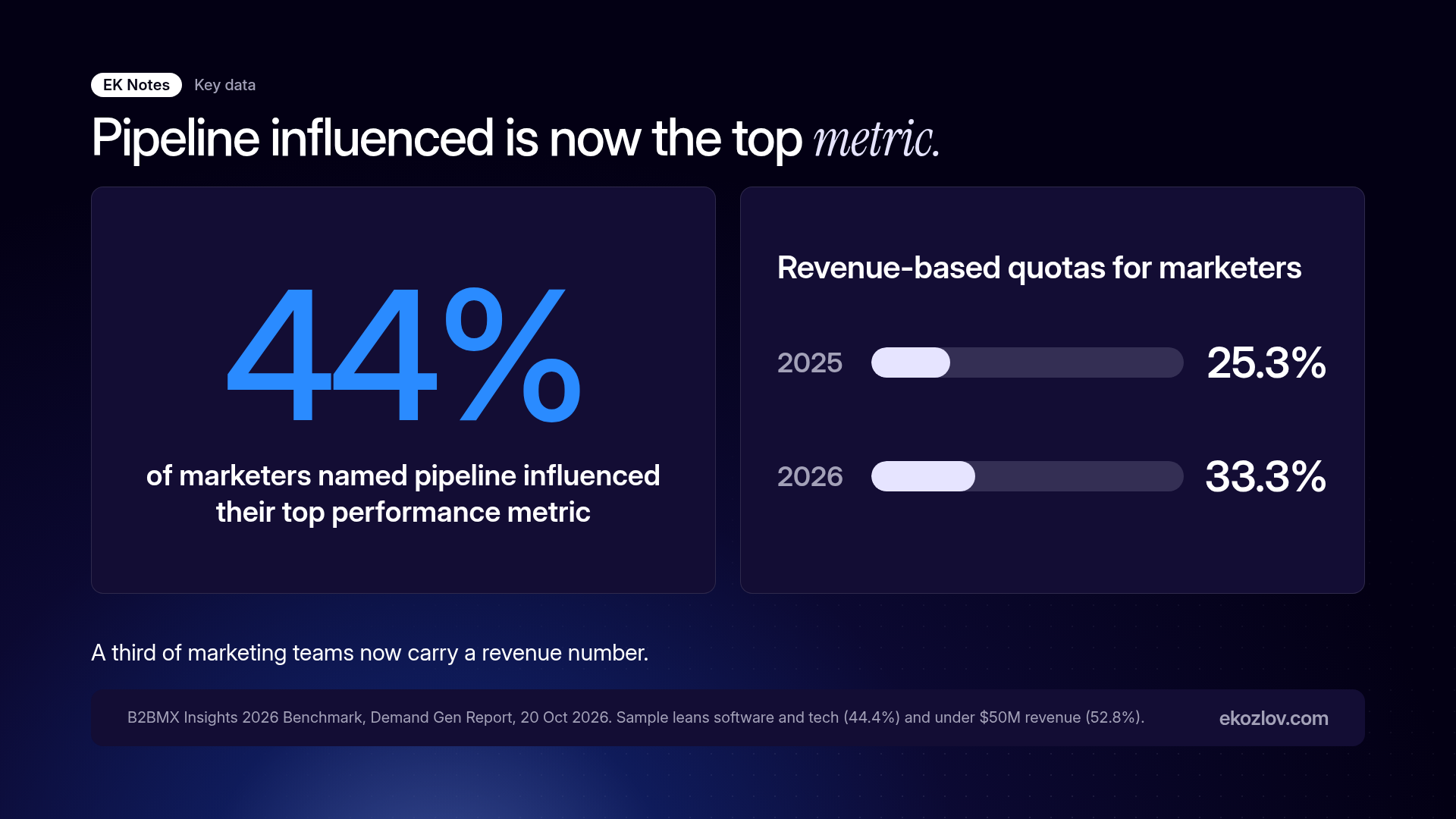
Pipeline influenced has become the number B2B marketing leads with. In the 2026 B2BMX Insights Benchmark, published by Demand Gen Report on 20 October, 44% of marketers named it their top performance metric. In 2025 the top spots belonged to opportunities generated and to MQLs and SALs.
The same report has a second number. Revenue-based quotas for marketers rose from 25.3% in 2025 to 33.3% in 2026. So a third of marketing teams now carry a revenue number, and the most popular way to report against it is a metric every function can claim at the same time.
The problem: a number with many parents
Influenced pipeline means marketing touched the deal somewhere. A webinar, an ad, a nurture email opened by someone on the buying committee. In a long cycle almost every deal qualifies. That is exactly why it climbed to the top. It is easy to grow, hard to dispute and impossible to own.
Sales has its own version. The rep booked the meeting, ran the demo and closed the deal. Partners count the same deal too. Add up every function's claim in the planning deck and the total can easily pass 100% of the pipeline.
Finance sees this every autumn. Sales builds a capacity plan on 3x coverage. Marketing builds a demand plan from last year's lead volume. Customer success forecasts renewals on its own. Finance stitches the three together. Tracy Hansen of SBI described exactly this on 21 October and called alignment in annual planning "a math problem", not a communication problem. Each plan is reasonable on its own. Together they don't connect, and the gaps don't show up until Q2.
I see influenced pipeline as the symptom of that split. When there is no shared model, every team needs a number that looks good inside its own plan. For marketing, influenced is that number.
The fix: one model, one name per number
The fix is not another weekly sync between sales and marketing. It is one working session before the 2027 plan locks, with the CMO, the CRO and the CFO in the room, plus whoever owns customer success.
Four things come out of that session:
- Shared definitions. What counts as a qualified opportunity, and what counts as marketing-sourced. If the definitions differ, the numbers cannot be added up.
- Last year's actual conversion rates, stage by stage. Not last year's plan.
- One funnel model built backward from the bookings target, so marketing's lead target is tied to the deals sales actually needs.
- One name next to every number. Marketing-sourced opportunities and lead-to-opportunity conversion belong to the CMO. Win rate and sales-sourced pipeline belong to the CRO.
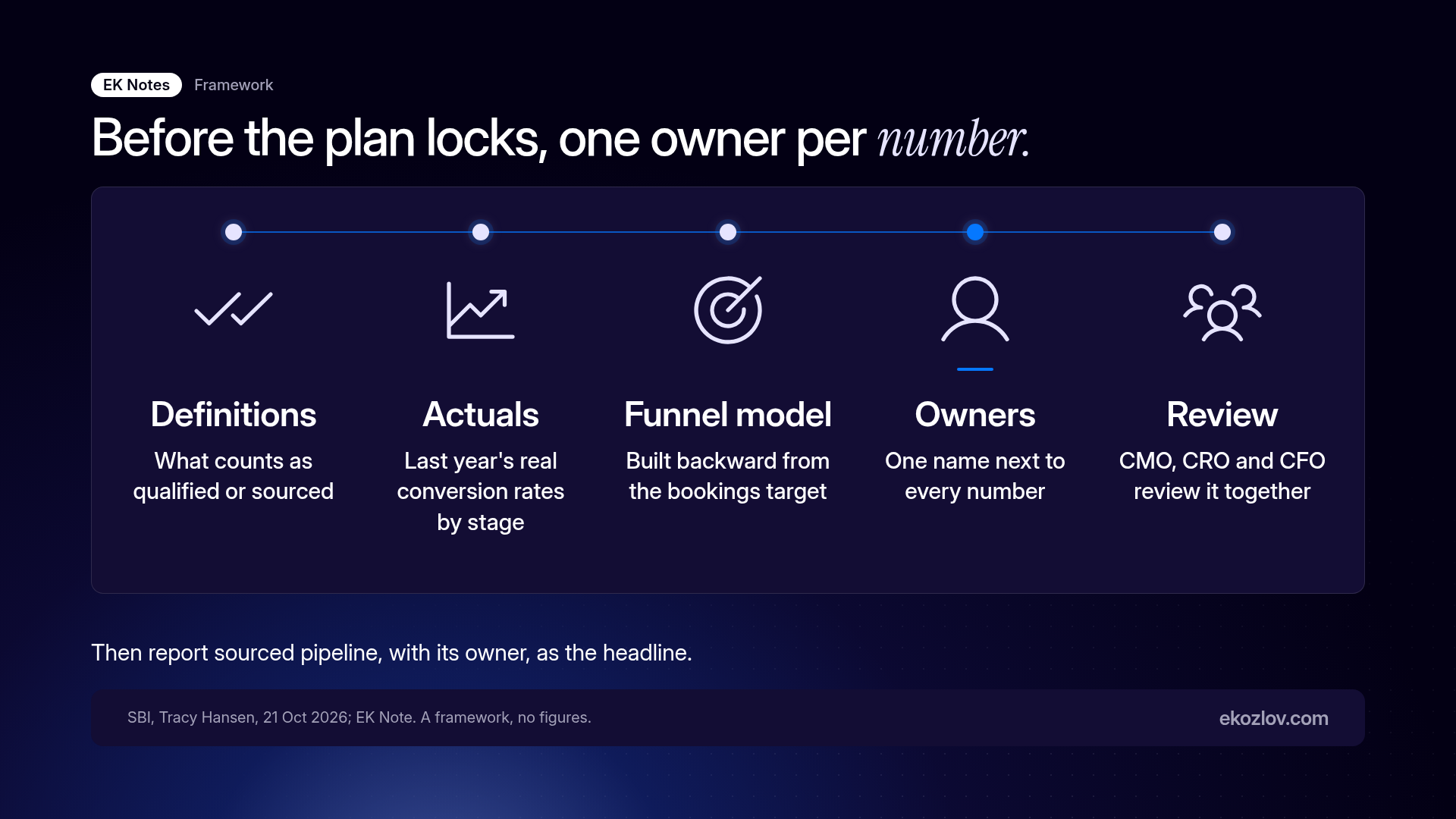
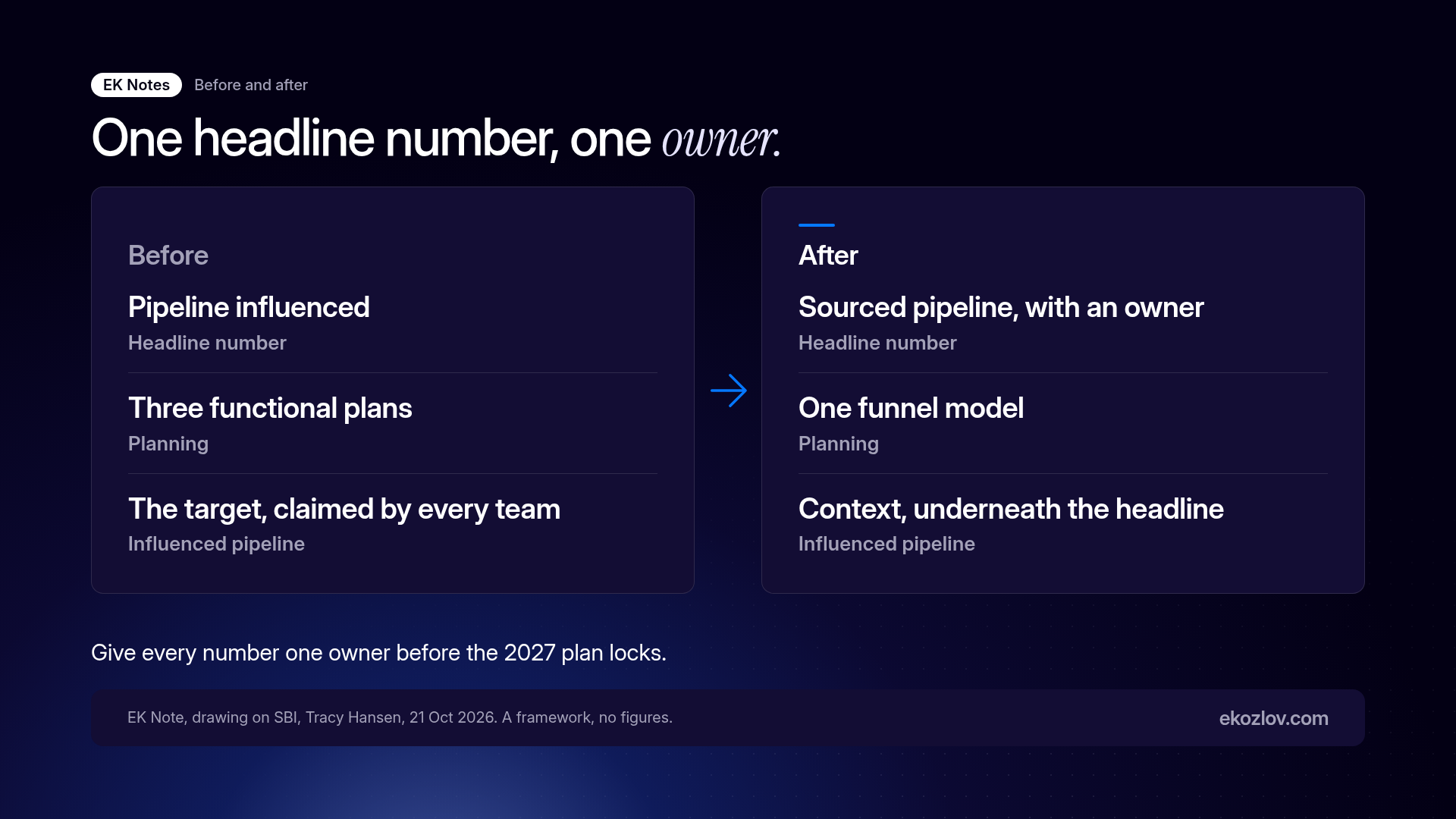
Then report sourced pipeline, with its owner, as the headline. Keep influenced on the slide as context, underneath it.
The proof: the arithmetic checks itself
The best argument for one model is that it shows its own mistakes. SBI's worked example starts from $28M in new logo bookings at a $70K average contract value: 400 deals. At a 22% win rate that needs about 1,820 qualified opportunities. If marketing sources 30%, its target is about 550 opportunities, and the conversion rate behind it is last year's real one.
Every number in that chain can be checked against last year's CRM, and every one has a person who has to defend it. Influenced pipeline has neither. It cannot be worked backward from bookings, because it overlaps with everything else in the plan.
SBI also offers a guideline worth testing: marketing is typically attributable for 25% to 35% of bookings. If your plan asks marketing to source 60%, either the business is unusual or the assumption needs checking. If it is far below 25%, demand generation may be underfunded. That is one consultancy's guideline, not a law. It is still a better opening argument than a figure nobody can disprove.
The brake
Influenced pipeline is not useless. In long, committee-driven cycles marketing shapes deals it will never source, and brand work mostly shows up as influence. Drop the metric completely and that work disappears at budget time. The mistake is making it the headline. A number everyone can claim belongs on the slide as context, not as the target.
Confirmed and plausible
Confirmed: the B2BMX Insights 2026 Benchmark figures (Demand Gen Report, 20 October 2026), read on 29 October. The sample leans towards software and technology companies (44.4%) and companies under $50 million in revenue (52.8%). Confirmed: SBI's four-step approach, worked example and 25% to 35% guideline, from Tracy Hansen's article of 21 October 2026, read on 29 October. The guideline is SBI's own.
Plausible, not proven: that teams with one owner on every planning number miss their targets less often. I found no public study that measures it. The session is cheap enough to test in this planning cycle.
Before the 2027 plan locks, put one name next to every number. A number with three owners has none.
Sources
- Demand Gen Report (James Hickey), "B2B Marketers Face Growing Pressure to Prove ROI as Revenue-Based Quotas Rise", 20 Oct 2026, read 29 Oct 2026 (revenue-based quotas 25.3% to 33.3%; pipeline influenced top metric at 44%, overtaking opportunities generated and MQLs/SALs; shared brand and demand campaigns 29.3% to 41.7%; 52.8% of respondents under $50M revenue, 44.4% software and technology.)
- SBI (Tracy Hansen), "Sales and Marketing Alignment Starts in the Annual Plan", 21 Oct 2026, read 29 Oct 2026 ("a math problem"; one funnel model built backward from bookings, shared definitions, a named owner for every number; worked example $28M, $70K ACV, 400 deals, 22% win rate, ~1,820 opportunities, 30% marketing-sourced, ~550; guideline that marketing is attributable for 25% to 35% of bookings; four steps ending in a CRO/CMO/CCO/CFO review.)
Related notes
- Hybrid pricing needs a worked example, not a credit tableIf buyers can't predict the bill, the deal stalls. Hybrid pricing is becoming the default, and its weak point is the explanation, not the maths. Marketing should own that explanation before the 2027 price change ships.
- AI shortlists drop vendors whose claims can't be verifiedThe claim nobody can check costs you the deal. AI builds the shortlist, but a vendor stays on it only when a stranger can confirm the claim. Before 2027 campaigns launch, give every top claim a named proof or cut it.
- Your traffic chart now counts agentsThe 2026 traffic chart behind your 2027 targets now counts AI agents browsing for buyers. Split people from agents before the target locks.