The marketplace is your new channel partner

In January 2013 Canonical announced a phone version of Ubuntu, and I wrote a short post about it on my blog. The system looked rather nice, judging by the screenshots. What worried me was the market it was walking into, one where Android already ruled. Canonical would have to sweat, I wrote, to find manufacturers ready to put Ubuntu on their devices by default. Otherwise it would stay pretty pictures for especially advanced geeks.
I had spent five years at Fly, a phone maker, so I read that announcement from the manufacturer's side of the table. Building a good system was the part Canonical knew how to do. Getting the people who owned the shelf to put it there was the part it had to win.
The first Ubuntu phone went on sale in Europe in February 2015, through online flash sales. In April 2017 Mark Shuttleworth wrote that Canonical would end its investment in the phone shell, and that "industry has not rallied to the possibility".
Them: the directory entry
The default goes like this. A product marketer fills in the listing once, uploads a logo and three screenshots, links the docs and moves on to the launch that feels real. There is no private offer ready for the accounts that ask. No services partner is named. Marketplace deals, when they happen, land in the general pipeline untagged, so a year later nobody can say whether the listing earned anything.
That habit fitted a world where a marketplace was a catalogue that buyers flicked through after they had already picked a vendor. It fits badly once the platform shows buyers what to consider and lets them pay with money they have already committed.
What changed in September and October
On 23 September Anthropic launched Claude Marketplace. It brings more than 2,000 connectors and plugins into one place, and customers can use a portion of their committed Anthropic spend to buy Claude-powered agents and products from companies such as CrowdStrike, Harvey, Legora and Snowflake. Consulting partners from the Claude Partner Network, Accenture, Boston Consulting Group and Deloitte among them, are listed alongside. The vendor quotes on the page spell out what this means for a seller. Snowflake talks about "cutting procurement cycles". Legora talks about buyers coming on board "using budget they've already committed".
On 6 October Microsoft's partner blog said that "Microsoft Marketplace sales have doubled year over year". Microsoft gives no base number, so treat it as the platform owner's own claim. The plumbing in the same post matters more to me. Multiparty private offers, which let a software company and its channel partners sell one deal together through the marketplace, expanded to 30 European countries on 27 May 2026 and to Australia, Japan and South Africa on 15 July. Customers can now map marketplace purchases to their purchase orders.
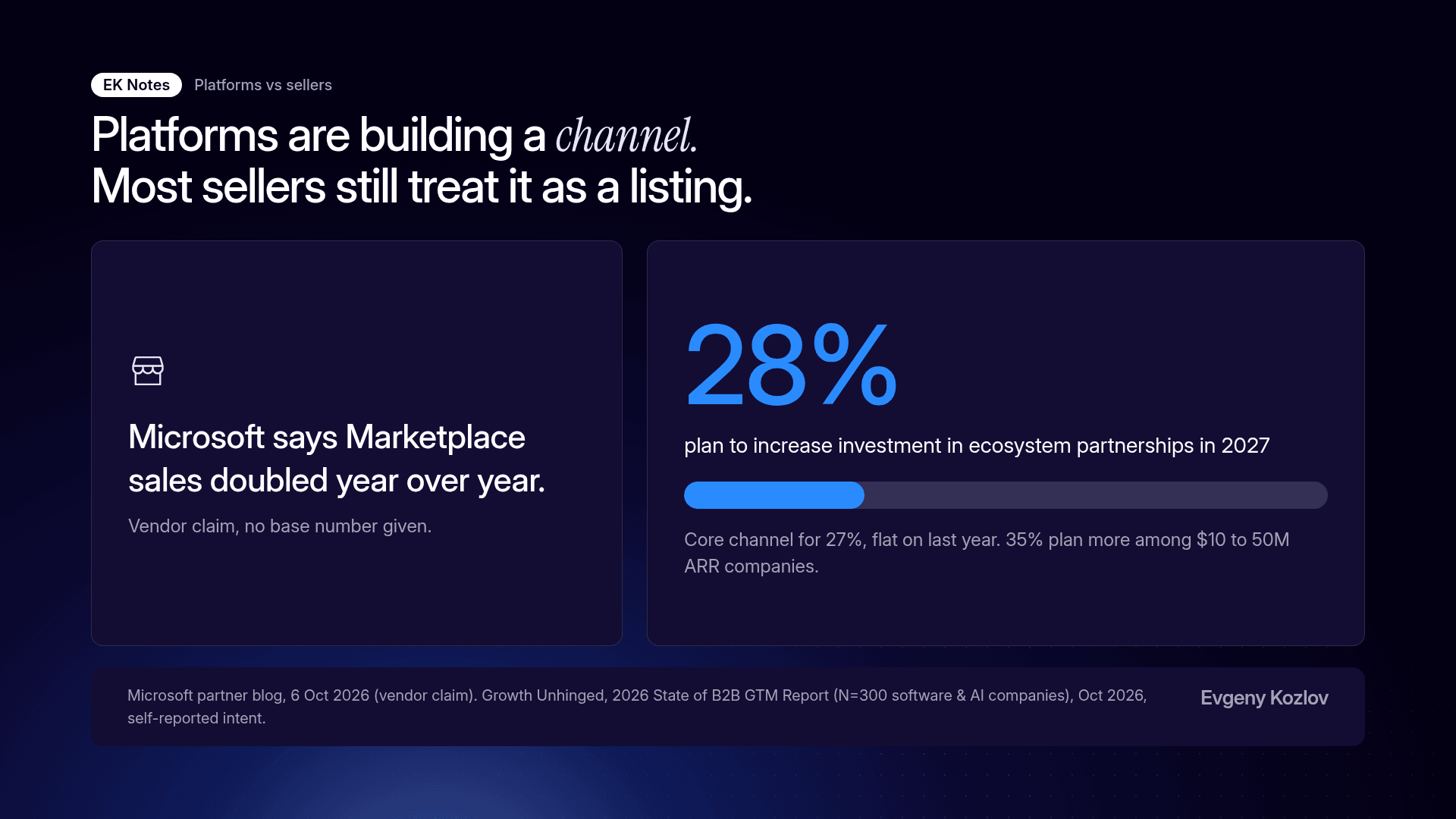
Look at what the buyer gets there: budget already approved, a procurement route already cleared, and a partner who can be written into the deal. In the phone business that package came from the operator or the retail chain, and they decided whose box went on the shelf. In 2026 the platform decides.
Us: the channel launch
I would plan a listing the way I would plan a new distributor:
- Choose one marketplace, the one where your target accounts already hold committed spend. Your account teams usually know which platform contracts the top 20 accounts have signed.
- Rewrite the listing for the way a buyer searches inside that platform, with the use case in the buyer's words, the integrations they already run and the answers their security reviewer will want.
- Prepare one private offer and one co-sell play with a services partner who already works in those accounts.
- Report marketplace-sourced pipeline as its own line, with its own target, for two quarters.
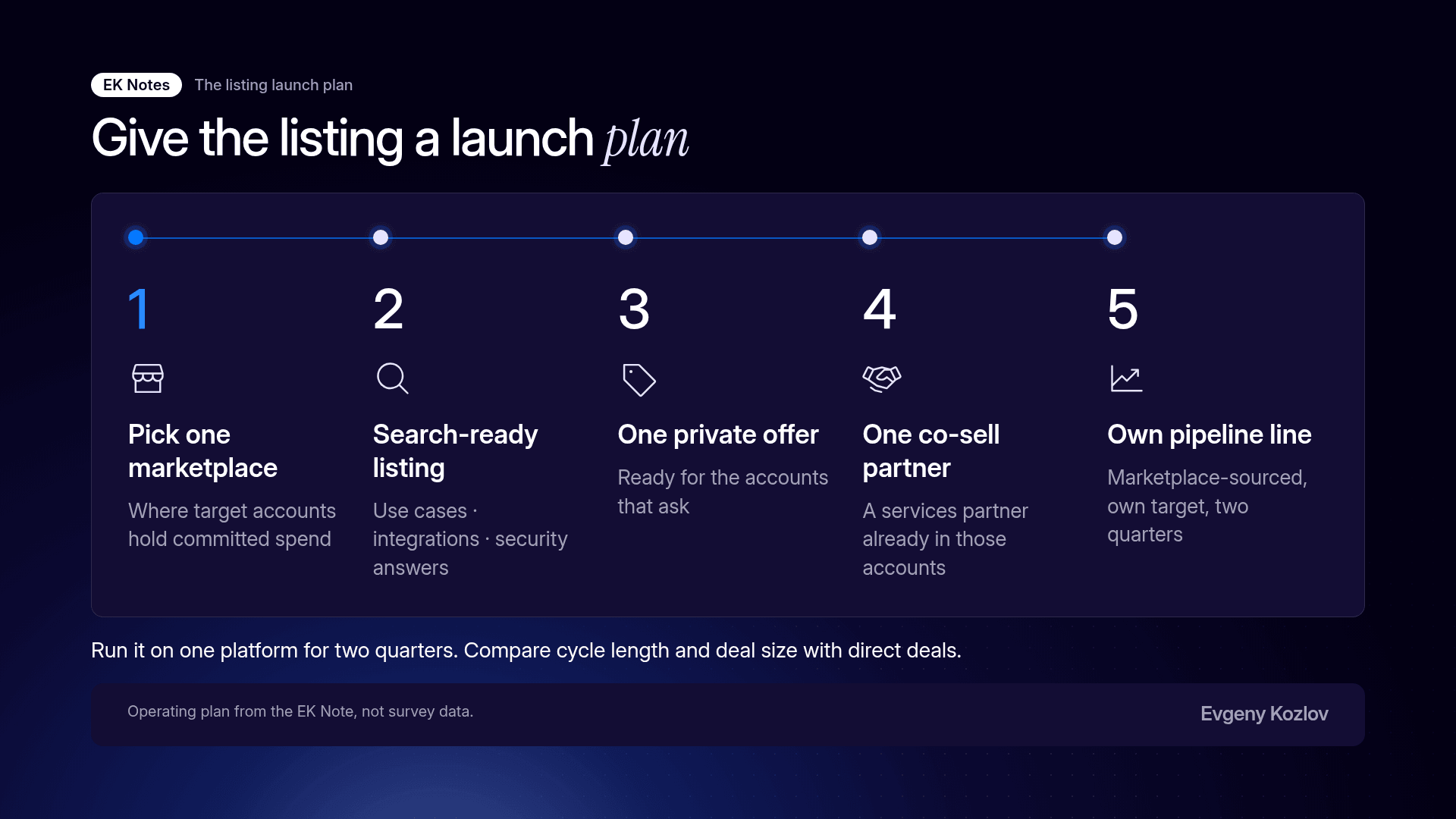
From directory entry to channel launch
Operating argument from the EK Note, not survey data.
Before: the directory entry
- Filled in once
- Logo and screenshots
- No private offer
- No partner named
- Deals untagged
After: the channel launch
- One chosen marketplace
- Listing written for in-platform search
- Private offer ready
- Co-sell partner named
- Marketplace pipeline as its own line

What is confirmed and what is not
Confirmed: the Anthropic and Microsoft details above, re-read on their own pages on 21 October 2026. Growth Unhinged's 2026 State of B2B GTM report (October 2026, 300 software and AI companies) shows how few sellers act on it yet. Ecosystem partnerships are a core channel for 27% of them, flat on last year, and 28% plan to increase investment in 2027, rising to 35% among companies with $10 to 50 million in ARR.
Plausible, not proven: that marketplace-sourced pipeline closes faster or larger for a typical B2B vendor. I found no public data on it. Every trigger here is a platform owner describing its own marketplace, plus partners quoted on the owner's page. The test is cheap. Run the launch on one platform for two quarters and compare cycle length and deal size with your direct deals.
The brake is real. A low-priced, self-serve product sold from your own site may never earn back marketplace fees and co-sell effort. The marketplace pays where buyers hold committed cloud or AI spend and procurement is what slows the deal down. If your deals stall in procurement and your buyers already sit on a platform contract, you are in the world where the listing needs a launch.
In 2013 I thought Ubuntu would stay pretty pictures unless someone put it on the shelf by default. A listing that nobody launches stays a pretty page.
Sources
- Anthropic, "Claude Marketplace: one place to discover plugins, agents, and services from our partners", 23 Sep 2026 (datePublished in page metadata), re-read 22 Oct 2026 (more than 2,000 connectors and plugins; "Use a portion of your committed Anthropic spend on Claude-powered software from companies like CrowdStrike, Cursor, Harvey, Legora, Lovable, and Snowflake"; Claude Partner Network partners "such as Accenture, Boston Consulting Group, or Deloitte"; Snowflake, Alexa Kelly: "cutting procurement cycles and accelerating time to value"; Legora, Kristin Thayer: "using budget they've already committed".)
- Microsoft, Andrew Smith, "What's new for Microsoft partners: October 2026 edition", 6 Oct 2026, re-read 22 Oct 2026 ("Microsoft Marketplace sales have doubled year over year", vendor claim, no base number given; multiparty private offers: "Following the May 27, 2026, expansion across 30 countries in Europe", Australia, Japan and South Africa on 15 Jul 2026; purchase order mapping.)
- Growth Unhinged (Kyle Poyar, Maja Voje), 2026 State of B2B GTM Report, October 2026, N=300, re-read 22 Oct 2026 (ecosystem partnerships "27% say it's core", p.16; "Flat", p.17; plan to increase 2027 investment 28%, p.28; 35% at $10-50M ARR, p.29.)
- Mark Shuttleworth, "Growing Ubuntu for cloud and IoT, rather than phone and convergence", Canonical blog, 5 Apr 2017 ("we will end our investment in Unity8, the phone and convergence shell"; "industry has not rallied to the possibility".) First Ubuntu phone (BQ Aquaris E4.5 Ubuntu Edition), on sale in Europe via flash sales, 9 Feb 2015: TechRadar; UBports history page.
- Evgeny Kozlov, "Ubuntu выходит на смартфоны в начале 2014 года" (Ubuntu is coming to smartphones in early 2014), ekozlov.ru blog, 3 Jan 2013
Related notes
- Your AI SDR is a deliverability programAn outbound agent on a big list mostly spends your sender reputation. Replies come from small segments, checkable facts and a human edit.
- The AEO checklist is not the leverFAQ blocks and schema do not get you cited. Pages written in your buyers' words do, and one visibility score cannot show it.
- The favourite is picked before the formBuyers often pick a favourite before filling in your form. Read it as a late signal and let them set the timing.