Your AI SDR is a deliverability program
- B2B marketing
- Platforms
- Lessons

The demo is always the same. An agent researches an account, writes an email, books a meeting. Then someone asks the obvious question: if one email costs almost nothing, why not send it to the whole addressable market?
Pointed at a big list, an AI SDR turns into a deliverability program, and what it spends fastest is your domain's reputation. In the data I found, replies go up with small segments, a couple of facts the buyer can check, and a person editing the final words. Sending more improves none of them.
Why this lands now
Salesforce announced job-ready Agentforce agents on 11 September. One of them, Hunter, is an outbound agent that, in Salesforce's words, "works a sales pipeline from research to outreach". It is in pilot now, with general availability planned for November 2026. Salesforce's own customer claim is that Perk builds 60% of its pipeline with it. Salesforce is quoting its own customer, so I would not treat it as a benchmark. Still, I expect a lot of teams will get an outbound agent switched on before 2027 budgets close.
What the reply data says
The best public data I found comes from a different Hunter. Hunter.io is an email-tool company with no link to the Salesforce agent. Its State of Email Outreach 2026 looks at 31 million emails its users sent in 2025.
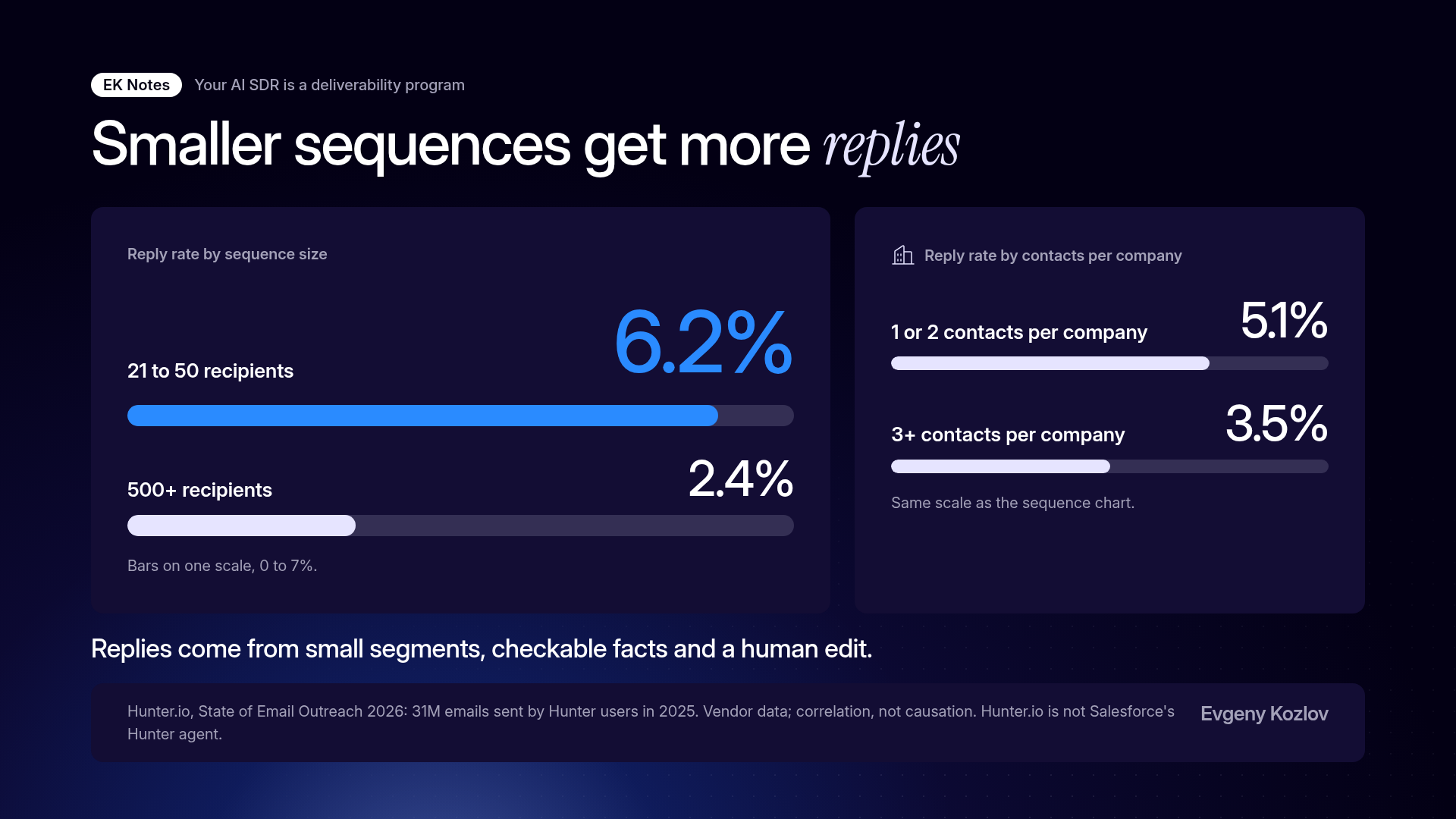
Sequences with 21 to 50 recipients got a 6.2% reply rate. Sequences with more than 500 got 2.4%. Emails with two custom attributes, such as real facts about that account, got 5.6%, against 3.6% for emails with no personalisation at all. Emails a person edited by hand got 5.2% against 4.4% for fully automated ones. Contacting 1 or 2 people per company got 5.1%; 3 or more got 3.5%. And 69% of the US-based decision makers Hunter surveyed said it bothers them if AI was used to write the email.
Firmable looked at the reader side. It surveyed 1,009 full-time professionals in August: 82% delete cold outreach on sight or skim and delete it. Looking mass-sent was the top red flag, named by 63%. When deciding whether to reply, 58% put relevance or value first, and only 13% said a human writing the message matters most. And 75% have blocked, muted or reported someone for repeated cold outreach. When that happens in email, blocks and spam reports are exactly what mailbox providers read about your domain.
Both are vendor reports, and that matters. Hunter's numbers cover its own users, not a random sample of senders, and they show correlation, not cause. Small sequences may simply be written by better reps. I have no comparable data for Cyprus, Malta, Kazakhstan or Azerbaijan. I read these as a direction to test.
The part that doesn't scale
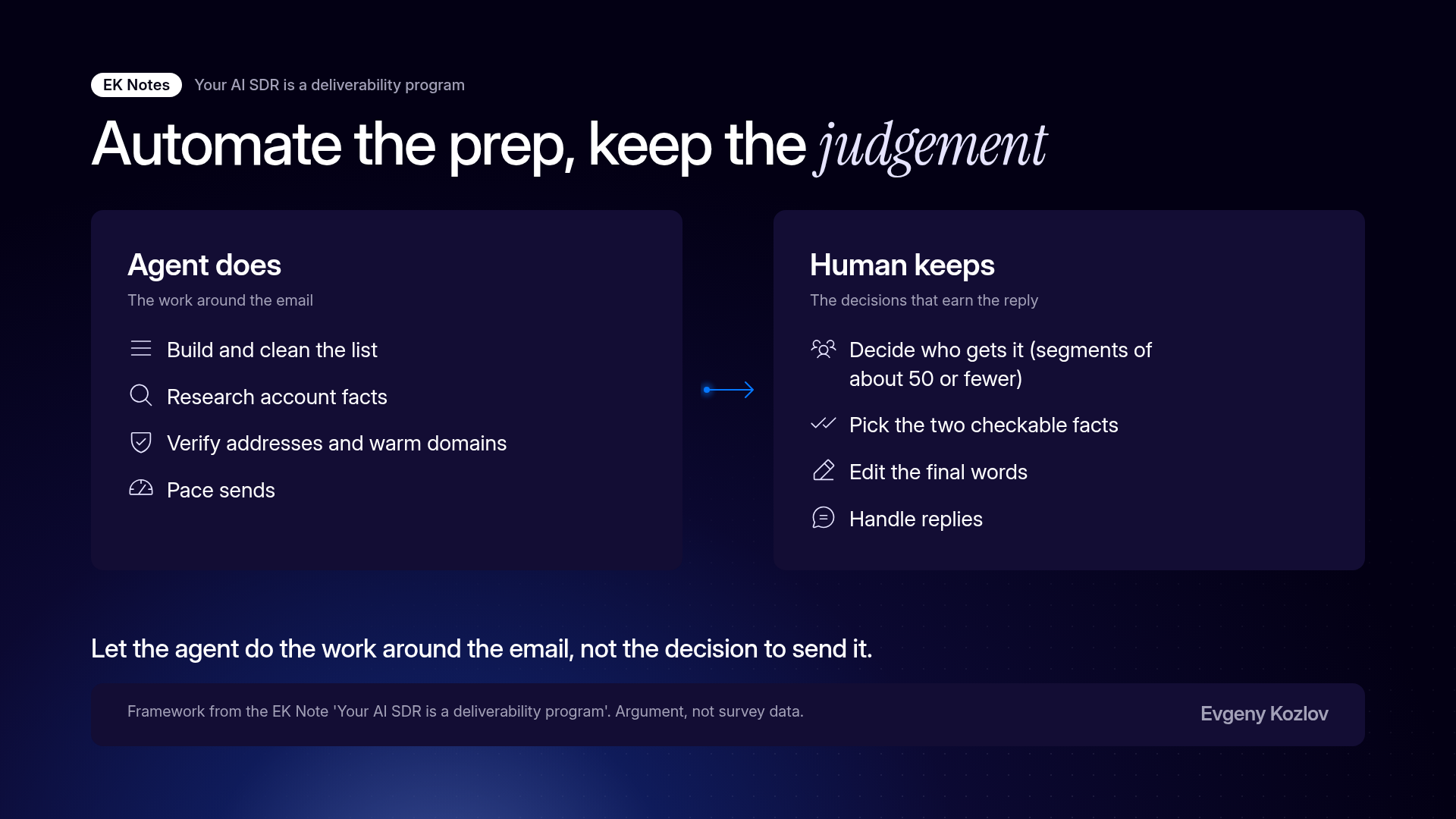
Taken together, what lifts replies is relevance a buyer can verify and restraint about who gets the email. An agent is very good at the work around that: building the list, pulling account facts, checking addresses, warming domains, pacing sends. It is the wrong owner for the decision to send 5,000 emails because it can.
Platform marketing has the same mechanics under other names. Frequency caps and audience fatigue exist because showing more people the same thing more often eventually costs more than it earns. Email has no automatic cap, and mailbox providers' spam filters do the job instead.
An agent working a warm list is another matter: event attendees, pricing-page visitors, inbound requests, accounts with a fresh trigger. There the segment is small by nature and the facts are already in hand, so automation can win. You can tell which world you are in from two things: where the list came from, and how many people are in each segment.
What I would change this week
I would make these changes before the agent goes live, since none of them costs much. (1) Cap each sequence at about 50 recipients per segment, and start with 1 or 2 contacts per company. (2) Require two facts per message that the buyer could check, and have a person edit the final words before anything sends. (3) Stop reporting emails sent and meetings booked. Report reply rate per segment, domain health, and how many meetings turn into opportunities.
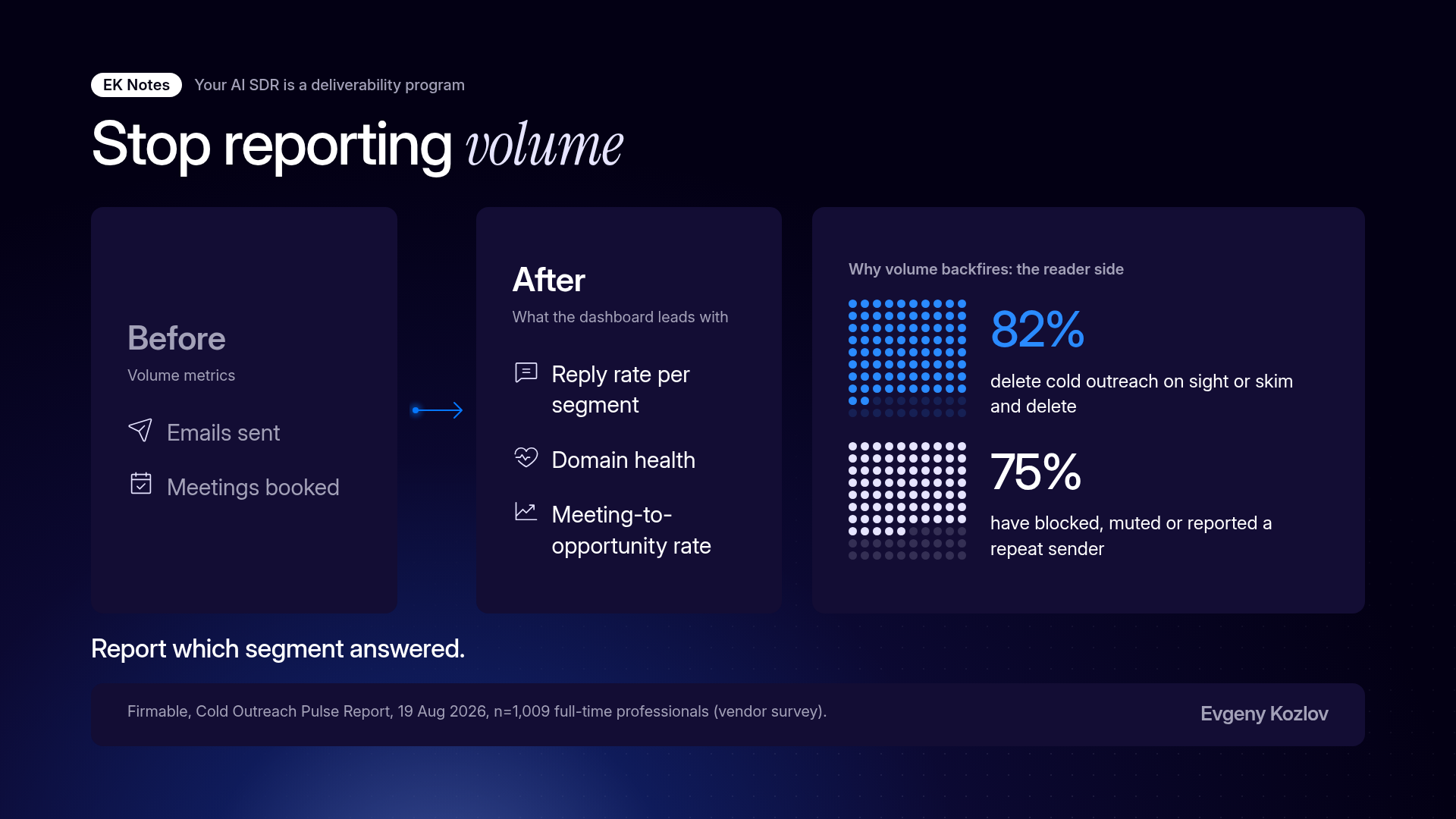
If your AI SDR dashboard leads with volume, it is mostly showing how fast you can spend a sender reputation, and I would want it to show which segment answered.
Sources
Related notes
- The AEO checklist is not the leverFAQ blocks and schema do not get you cited. Pages written in your buyers' words do, and one visibility score cannot show it.
- The favourite is picked before the formBuyers often pick a favourite before filling in your form. Read it as a late signal and let them set the timing.
- Your CRM needs a write policyWhen agents start updating your CRM on their own, the hard question is no longer data entry. It is who owns each field.