The favourite is picked before the form
- B2B marketing
- Lessons
- Platforms

A form comes in on a Tuesday afternoon. The SLA says call within five minutes, so someone does. The buyer picks up, a little surprised, and says they are just comparing a few options. The rep logs it as early stage. Three weeks later the deal goes to a competitor the buyer had preferred since before they typed their name into anything.
I think a lot of B2B follow-up is built on that misreading. We treat the form-fill as the start of the deal. For many buyers it comes near the end of their own process, after the favourite is already picked.
What the Japanese data shows
On 5 October, IDEATECH, a Tokyo marketing and research firm, published an "AI-era B2B buyer journey map" built on three of its own surveys from this year. The latest wave, run 7–19 August, asked 502 people who had been involved in B2B IT purchases of ¥5 million or more in the past year how they actually bought.
For 74.3% of them, the vendor they finally chose had become the leading candidate by the end of the deep-comparison stage. That count includes people who had a favourite before they started looking at all. 90.6% used generative AI somewhere in the selection, and 53.8% built their vendor comparison table with it.
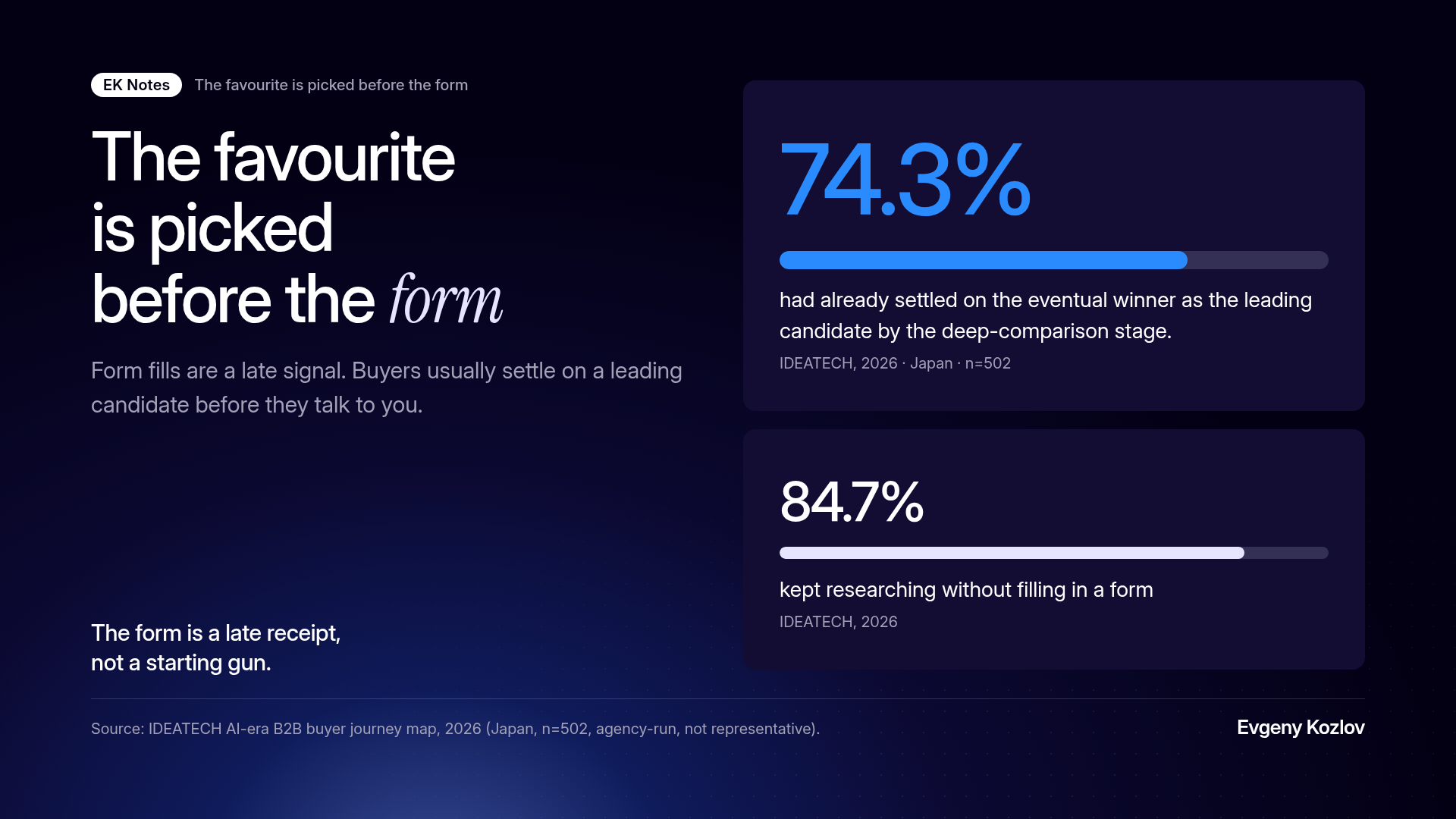
The form numbers matter most for follow-up. 84.7% had wanted a candidate vendor's materials, pricing or case studies at some point and kept researching without filling in the form. Of those 425 people, 44.7% did not want anyone to know they were evaluating yet, and 44.5% thought generative AI would give them the same information. Asked what they wanted when they did fill in a form, 43.0% said contact only after they had compared further, 27.3% said contact only if they asked for it, and 15.3% wanted to hear from sales right away.
Before talking seriously to sales, they wanted concrete pricing (56.8%), a comparison or selection guide to judge fit (48.0%) and case studies from similar companies (42.0%).
Some cautions before this goes into a deck. This is Japanese data, run by an agency through its own research product, and IDEATECH sells content and LLMO services. The firm says plainly that the surveys are not representative of Japanese B2B buying as a whole, do not show a causal effect of AI, and cannot be compared across waves. A leading candidate is also not a signed contract. I have no comparable numbers for Cyprus, Malta, Kazakhstan or Azerbaijan, so in the markets I work in this is a hypothesis to test. One Western survey leans the same way: in LeadSpot's Q3 2026 study of 540 B2B buyers and demand-gen leaders, 43% said they skip a gated form if an AI tool can summarise the content. LeadSpot is a content syndication vendor, so read that as a signal too.
Five minutes is the wrong answer
A speed-to-lead SLA assumes that whoever fills in a form wants to talk now. In this sample, fewer than one in six did. For the rest, a call within minutes answers a question they did not ask, and it arrives just as they are trying to finish comparing without being noticed.
The form also says less than the dashboard suggests. In the same survey, 41.2% had filled in a form for a vendor that was never a candidate, only to collect information. So one form-fill can be a buyer who decided weeks ago, and the next can be a buyer who will never shortlist you. The MQL report counts them the same.
There is a brake on this. A demo request from your pricing page, or a list from an event where people asked for a meeting, still deserves a fast reply. Some buyers do want the call, and the fix is to let the buyer choose the timing rather than slow everyone down. A favourite can also lose late, in procurement or a security review, so late-stage deals still need work.
What I would change this week
My work sits on the platform side of advertising, where lead forms and quick follow-up get a lot of attention. Three changes look cheap enough to try now. (1) Publish your pricing logic and a fit or comparison guide without a gate. They were the two things buyers most wanted before sales, and a buyer who cannot find them will ask an AI tool, which answers either way. (2) Add one question to the form: when should we contact you? Now, after I have compared, or only when I ask. Route only "now" into the five-minute queue, and honour the other answers. (3) In win/loss interviews, ask "were we already your favourite before the first sales call?" and track that share next to form volume.
The third number is the one I would watch. If most of your wins were already the favourite before sales spoke to the buyer, the form is a late receipt for work done earlier: your pricing page, your comparison content, and whatever the buyer's AI tool says about you. I would fund that work and let the form tell me when to call.
Sources
More on the feed economy on stage: IMH·iFX EXPO.
Next in this series · B2B marketingThe AEO checklist is not the leverRelated notes
- Your AI SDR is a deliverability programAn outbound agent on a big list mostly spends your sender reputation. Replies come from small segments, checkable facts and a human edit.
- The AEO checklist is not the leverFAQ blocks and schema do not get you cited. Pages written in your buyers' words do, and one visibility score cannot show it.
- Your CRM needs a write policyWhen agents start updating your CRM on their own, the hard question is no longer data entry. It is who owns each field.