Fund the list, not the booth

In March 2014 I worked my first Mobile World Congress as an exhibitor, on UBANK's modest stand in Barcelona. For four days I didn't see a single new gadget, because there was no time to visit the big brands' stands. My Fitbit still counted at least 15,000 steps a day. On the first day we ran out of the several thousand booklets printed for the whole show and had to order a couple of thousand more at short notice. It wasn't cheap, I wrote afterwards, but it was worth it.
Reading that post now, I notice what I counted: booklets and steps. Nowhere in it is a list of the people we came to meet.
That is the trouble with a booth. It is rented floor, and a floor rewards volume: leaflets handed out, badges scanned, leads per show. The calendar gets renewed because last year's shows are already on it, and in 2027 that habit gets more expensive.
The money is moving to smaller rooms
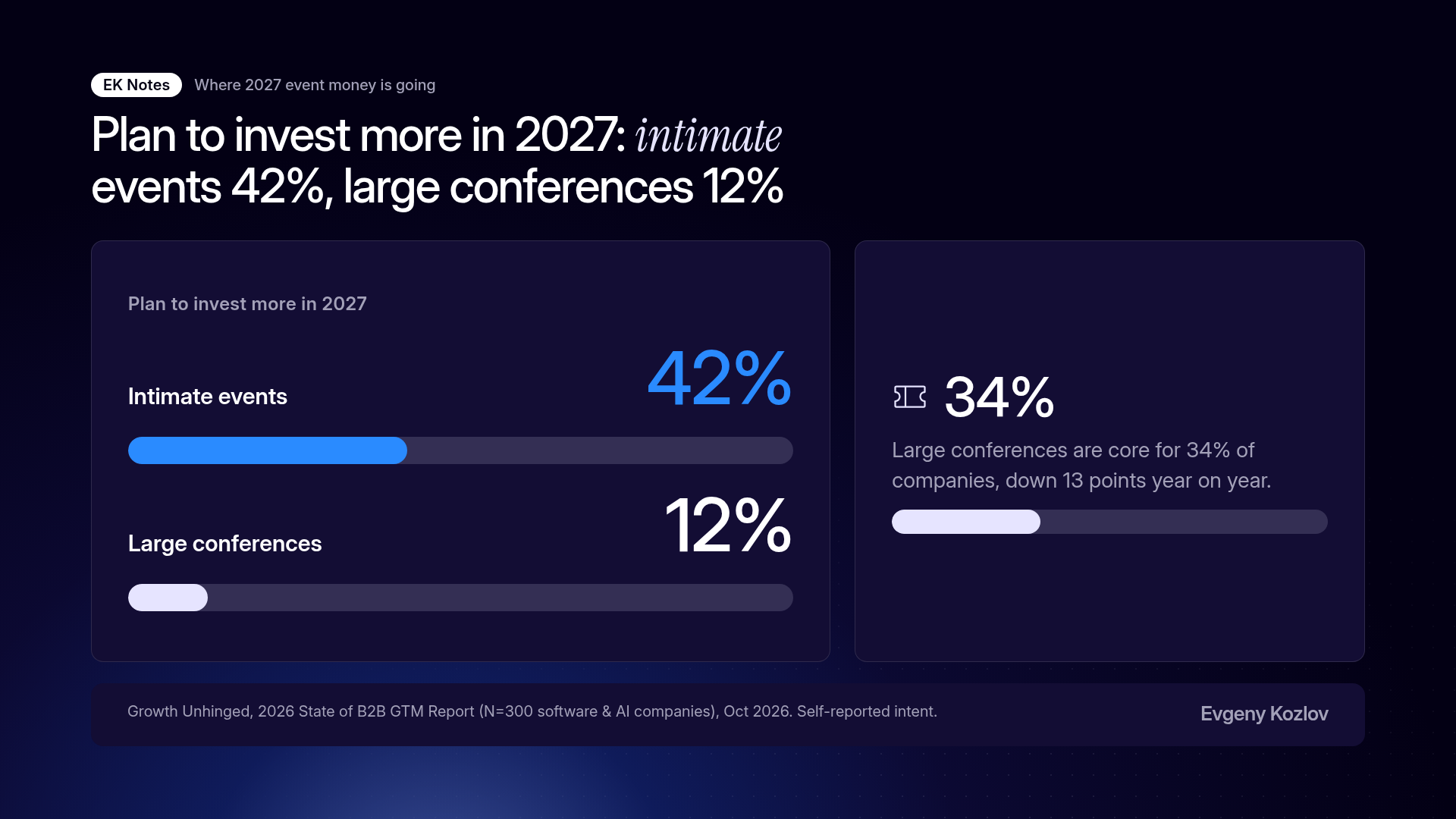
Growth Unhinged's 2026 State of B2B GTM report (Kyle Poyar and Maja Voje, October 2026) polled 300 software and AI companies in September. Large conferences are a core channel for 34% of them, down 13 points on last year. Asked where they will increase investment in 2027, 12% named large conferences and 42% named intimate events. Intimate events also saw the biggest jump on last year's survey. One respondent summed up what didn't work: "Attending too many large events, lot of effort (if speaking) and honestly not great ROI, too crowded."
Costs push from the other side. InEvent's State of Enterprise Events 2026 (October 2026, more than 2,000 event professionals) found that 67% expect their event budgets to rise in 2027, but only 6.5% expect a significant increase. 71% expect costs to keep rising, and cost per attendee is already up about 6% year on year. Most teams will get a little more money and pay more for every person in the room.
The fix is a named list, written before you book
By 2017 my team had spent two years looking at more than 50 marketing and mobile events, with only a couple of people in marketing. I wrote up our rules that October, and one of them did most of the work. Before each event I asked everyone going to get together, go through the list of who would be there and split it into three groups: should meet, good to meet, potential. For the first group we ideally prepared a tailored deck that reflected the client's business, or at least its vertical. We also favoured organisers who would share the attendee list.
Here is how I would turn that into a 2027 budget rule:
- For each show, write down the 30 to 50 named accounts you expect to be there, and tier them should meet, good to meet, potential.
- Book the should-meet meetings before you fly. The stand, if you have one, is where they happen.
- Afterwards, report three numbers: listed accounts met, meetings booked before the show, and opportunities opened with those accounts within 90 days. Badge scans can go in the appendix.
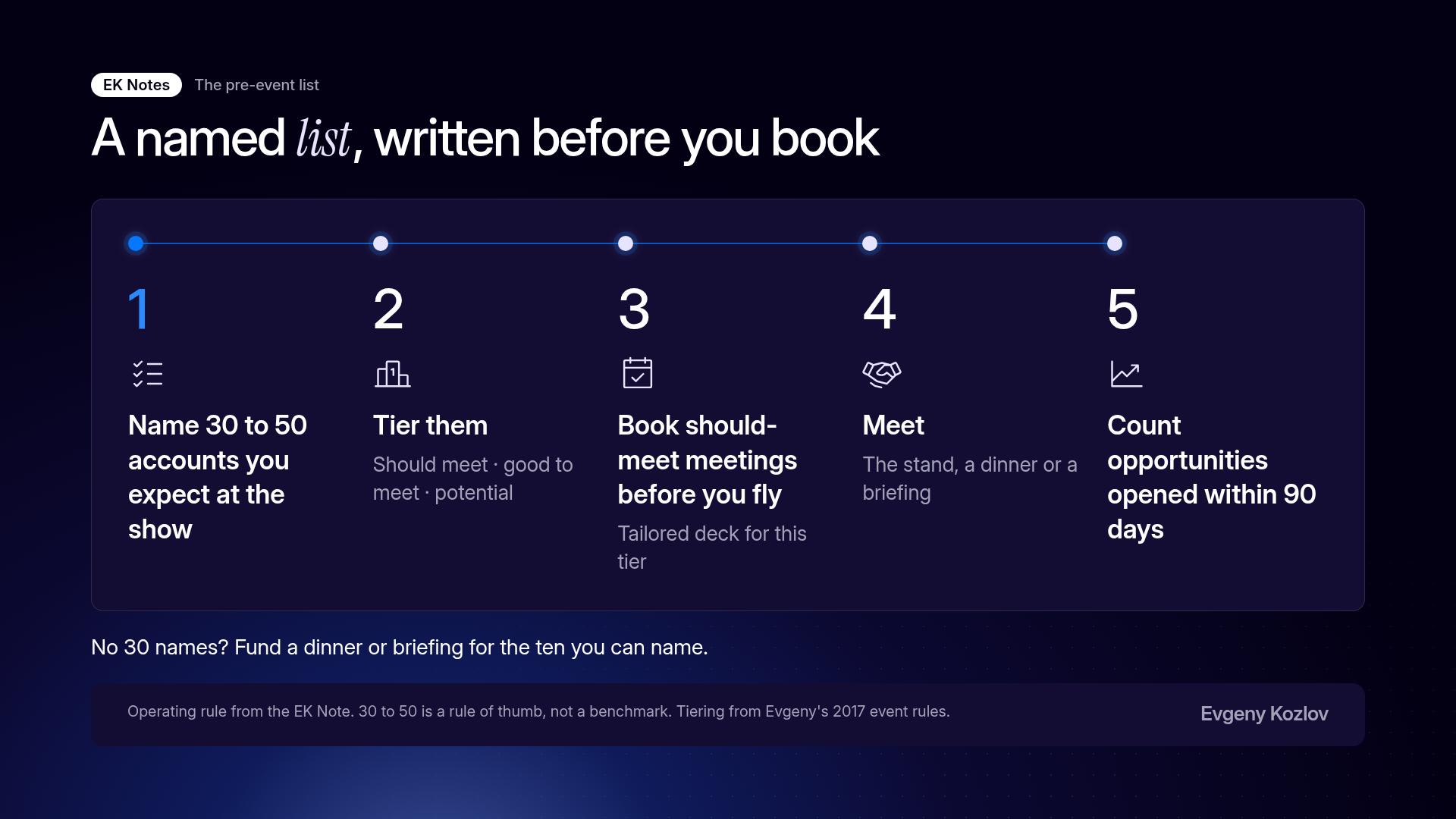
If you can't name 30 accounts for a show, fund a dinner or an executive briefing for the ten you can name. The 30 to 50 range is my rule of thumb; no survey measured it. Set yours by deal size and by how many people you can send.
From badge scans to listed accounts met
Operating argument from the EK Note, not survey data.
Before: the booth report
- Booth size
- Badge scans
- Leads per show
After: the list report
- Listed accounts met
- Meetings booked pre-show
- Opportunities at 90 days

What counts as proof
Confirmed: every figure above is as published in the two reports. InEvent also reports that the share of event teams struggling to prove ROI fell from 70% to 40% in a year, a change it links to connecting event data with the CRM. 52% of its respondents attribute at least half of their closed-won deals to in-person events.
Read both with the caveats on. Growth Unhinged is presented by a marketing platform, Ploy, with sponsor partners, and its sample leans towards AI-native companies and deals of $5k to $50k a year. InEvent sells event software, including badge printing and lead retrieval, and its respondents are event professionals rating their own channel. All of it is self-reported intent, and planned spend is not actual spend.
Plausible, not proven: that a tiered list raises pipeline per event. I know of no public data that tests it. It is cheap to test on two shows next half-year. If meetings with listed accounts don't open more opportunities within 90 days than the badge-scan follow-up does, the booth has earned its place.
There is a brake. In some categories the whole buying committee turns up at one show, as it often does at MWC for mobile and telecom, and there the stand is the meeting room. Even in the Growth Unhinged data, 29% of companies with deals above $50k a year put large conferences in their top three channels. So keep the booth where your list will walk past it, and write the list first.
In 2014 we spent the extra money reprinting booklets on day one. Today I would spend it on a dinner for the should-meet group, booked weeks before the doors open.
Sources
- Growth Unhinged (Kyle Poyar, Maja Voje), 2026 State of B2B GTM Report, October 2026, N=300 software and AI companies polled September 2026 (large conferences core for 34%, down 13 points, p.16–17; respondent quote, p.18; 2027 investment plans: intimate events 42%, large conferences 12%, "Intimate events saw the biggest increase compared to last year's report", p.28; >$50k ACV: large conferences in top 3 for 29%, p.20; sample includes "a large sample of AI-native companies and those with deal sizes of $5-50k per year", p.3; presented by Ploy, p.2.)
- InEvent, "Event Professionals Expect Event Costs to Rise in 2027 While Budgets Barely Grow", press release on the State of Enterprise Events 2026, October 2026 (2,000+ event professionals, platform data from 50,000+ events) (67% expect budgets to increase, 6.5% significantly; 71% expect costs to keep rising; cost per attendee up about 6% YoY; 52% attribute at least half of closed-won deals to in-person; struggling to prove ROI 70% → 40%, linked to centralised event data and CRM integration.)
- Evgeny Kozlov, "Впечатления от выставки MWC 2014 в Барселоне" (Impressions from MWC 2014 in Barcelona), ekozlov.ru blog, 10 Mar 2014
- Evgeny Kozlov, "7 принципов, по которым мы выбираем конференции для участия" (7 principles for choosing conferences), ekozlov.ru blog, 20 Oct 2017 (written for VC.ru)
Related notes
- Hybrid pricing needs a worked example, not a credit tableIf buyers can't predict the bill, the deal stalls. Hybrid pricing is becoming the default, and its weak point is the explanation, not the maths. Marketing should own that explanation before the 2027 price change ships.
- AI shortlists drop vendors whose claims can't be verifiedThe claim nobody can check costs you the deal. AI builds the shortlist, but a vendor stays on it only when a stranger can confirm the claim. Before 2027 campaigns launch, give every top claim a named proof or cut it.
- Ask for the layer under the headlineFour sessions at Israel Mobile Summit, one habit I took home. Before you act on a vendor's headline, ask for the fact one level below it.