Ask for the layer under the headline
Last week I wrote up the day at Israel Mobile Summit in The whole app chain in one day. That note was about the place and the people. This one covers what the speakers said and how I would use it.
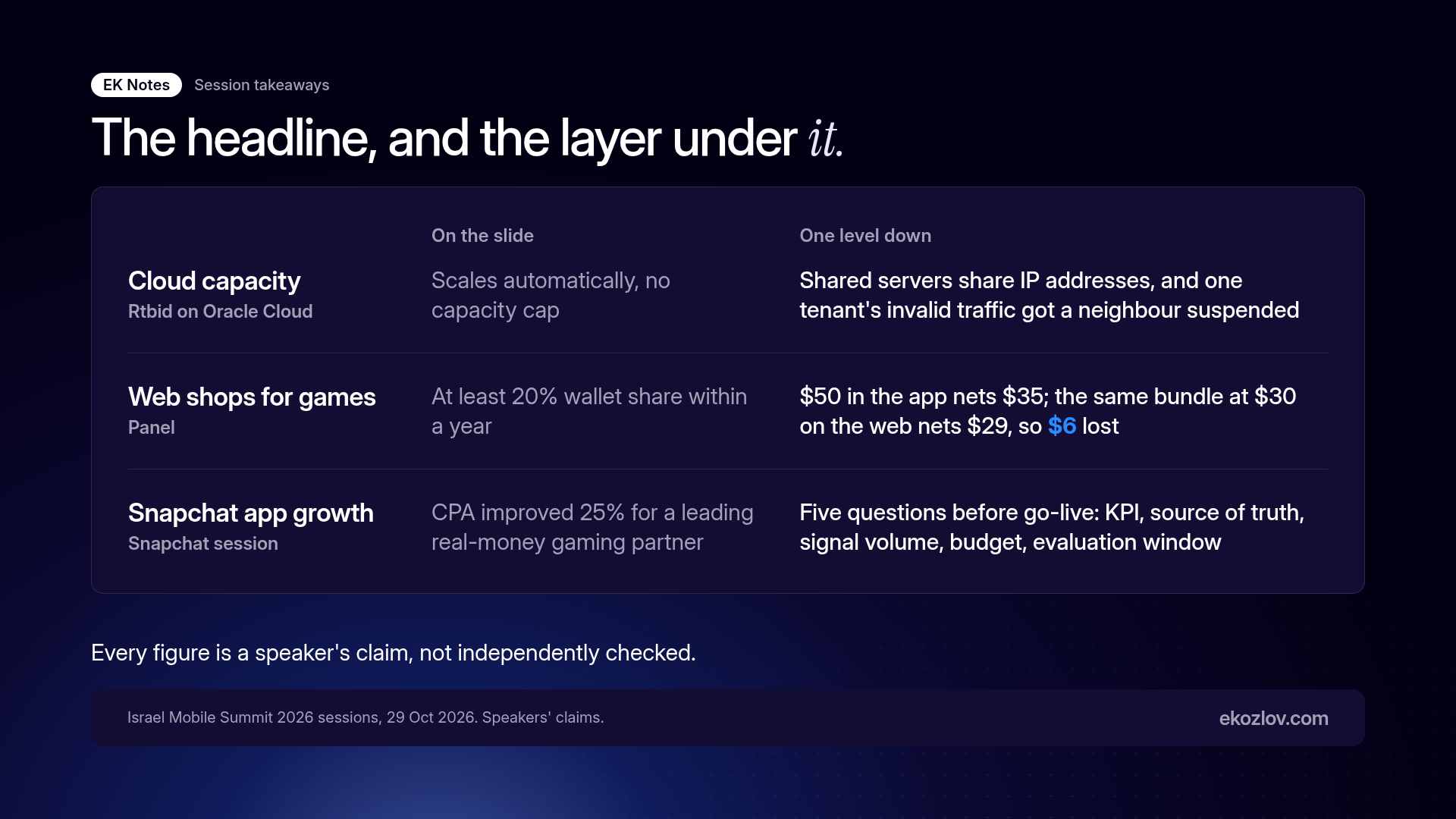
I followed four sessions, and in my notes each has the same shape. The talk has a headline, and the speaker's own material then gives the fact that decides whether it holds. That is the claim of this note: the headline is the easy part, and the deciding fact sits one level below it. Every figure below is a speaker's claim from the stage. I did not check them independently.
Cloud capacity: from "it scales" to "who shares your address"
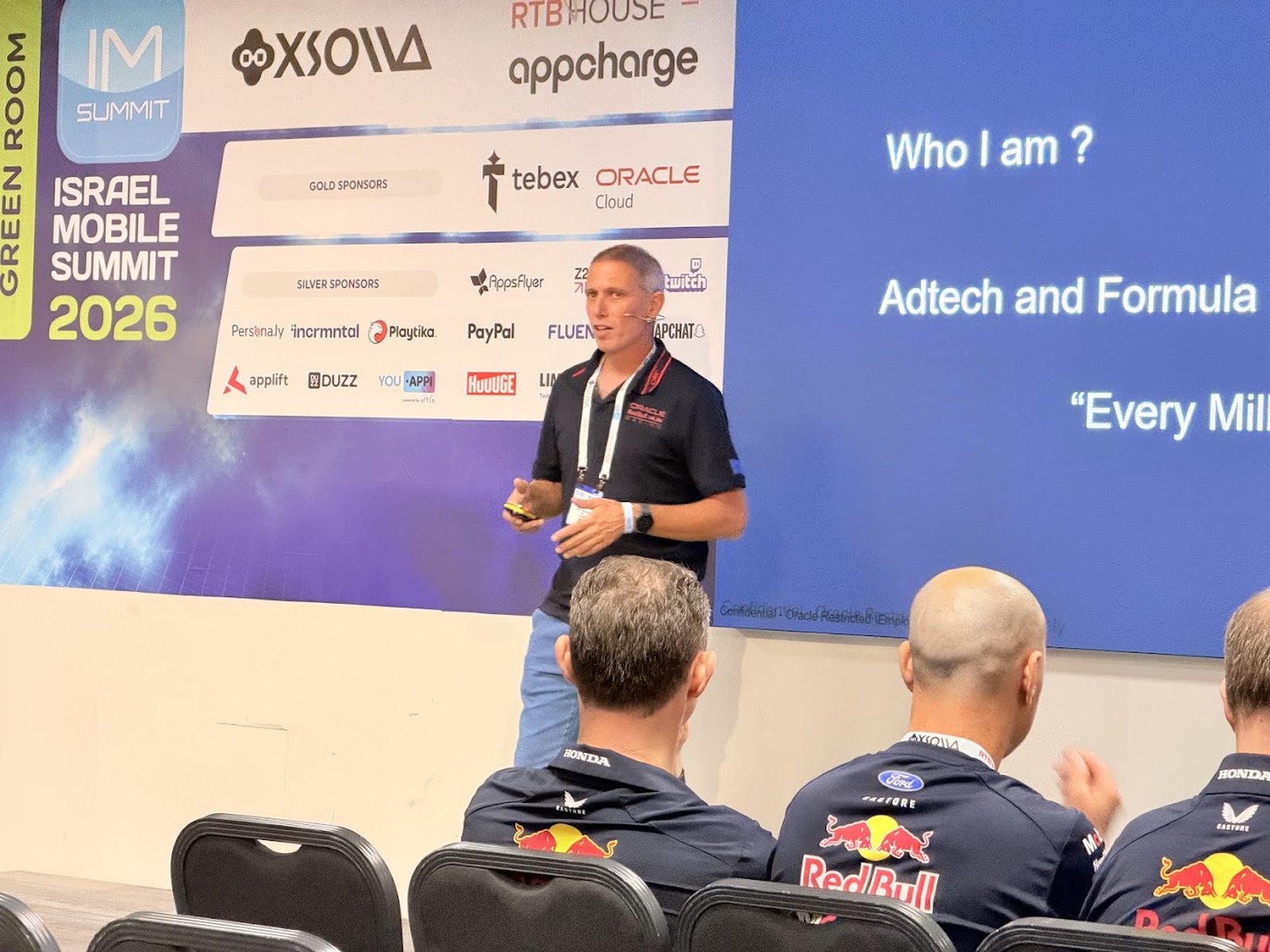
The headline. Oracle's Avi Zabary opened with Formula 1, where decisions are made in milliseconds, and said Red Bull Racing runs on Oracle Cloud Infrastructure. Elad Yosifon, founder and CEO of Rtbid, said his ad serving platform scales automatically on that cloud, with no capacity cap.
The layer under it. The more useful part was his account of shared infrastructure. Clients on shared servers also share IP addresses, so demand platforms see them as one entity. He described an early client that a top supply platform suspended without warning, because another tenant sent invalid traffic from the shared IP. The client lost its premium seats and came close to bankruptcy through chargebacks.
How I would use it. Before the Q4 plan locks, ask your ad tech, email and tracking vendors: what happens to capacity at peak, and who else sits on your IP address and domain. Put both in the vendor review, not the post-mortem.
Direct-to-consumer web shops: from share to net value
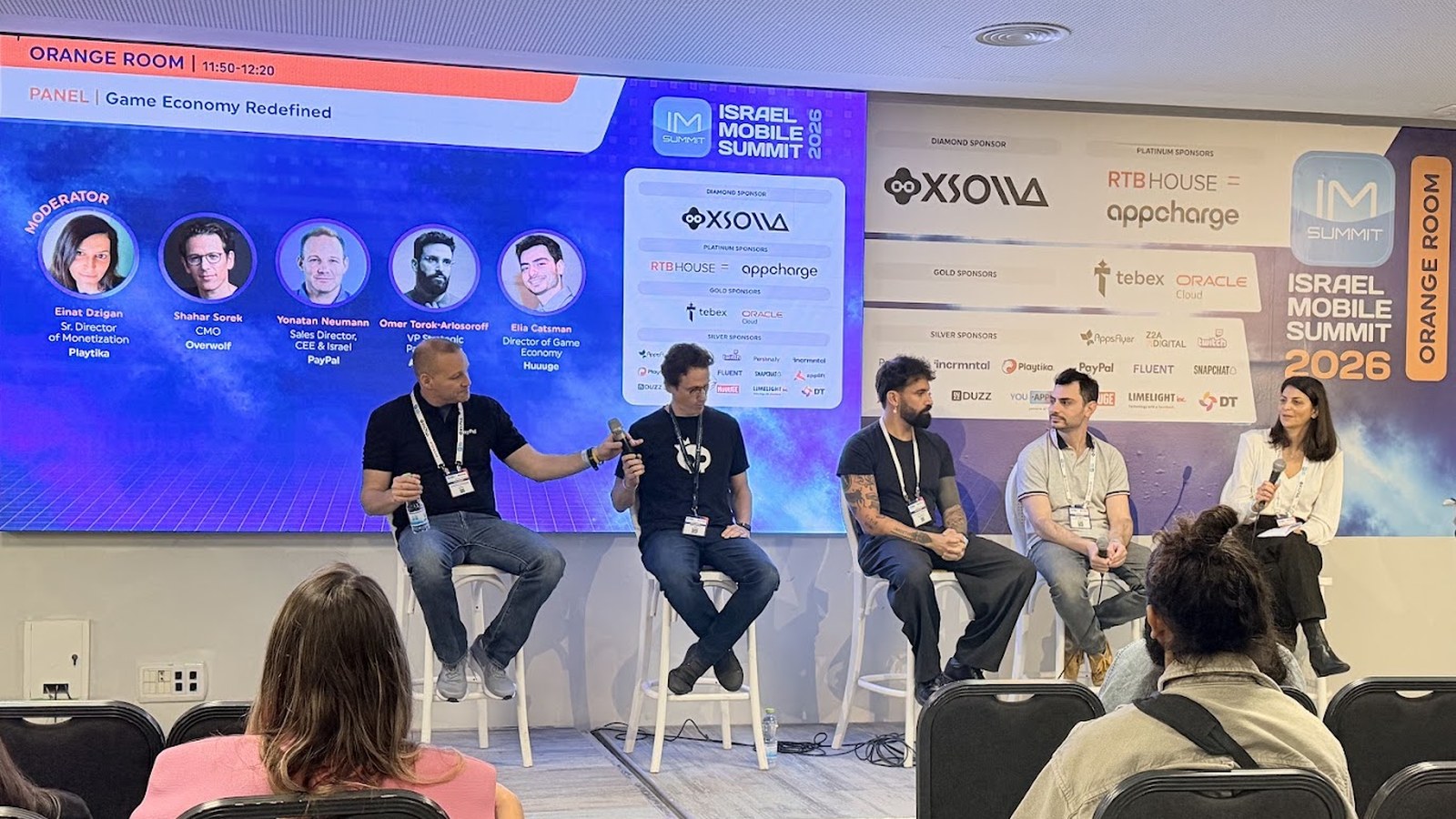
The headline. On the panel about web shops for games, one panelist said a studio with the right strategy should reach no less than 20% wallet share on its own web shop within a year.
The layer under it. The same panelist called that the easy part. The hard part is the habit of players returning to the web shop on their own. Another panelist did the arithmetic: the discount you can offer is capped by the commission you save. A player who pays $50 in the app nets the studio $35. The same bundle at $30 on the web nets $29. Share goes up, a new direct customer appears, and the studio is $6 down. The advice was to offer something unique that players do not see in the regular game. On drop-off, a panelist named the first transaction, and the fixes were a smooth checkout, the right payment methods and a saved card.
How I would use it. Before any web shop promotion, report net revenue per player in the store and on the web, next to share. Treat the first purchase as a conversion problem: checkout speed, payment methods by market, saved card. The PayPal panelist said the shift is not only for games, so other app marketers can run the same arithmetic.
Snapchat: from a 25% result to five questions
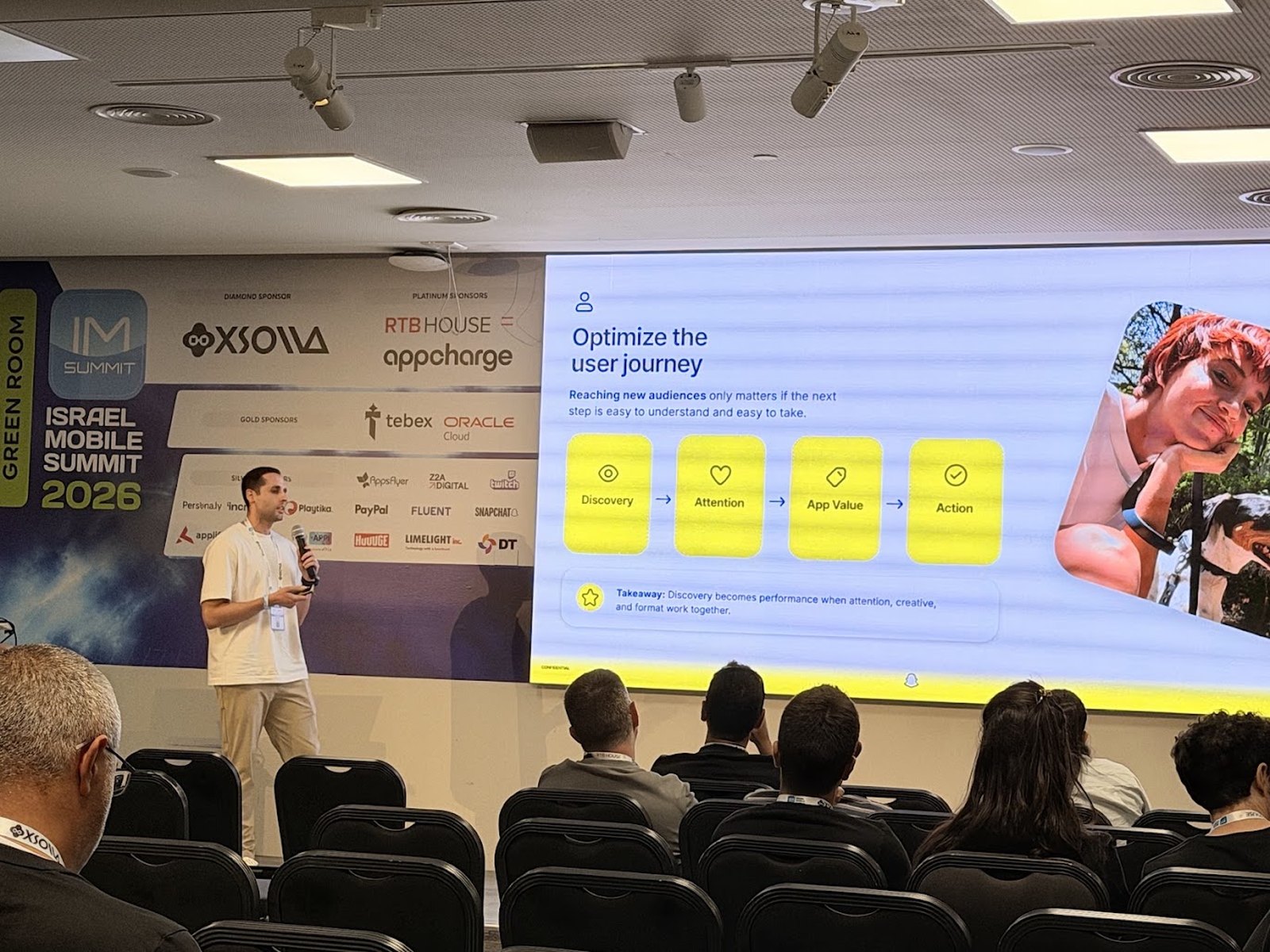
The headline. Snapchat's session on app growth cited a leading real-money gaming partner whose CPA improved by 25% with unified attribution, and a 25% rise in installs when the App Power Pack tools are used together. The partner was not named.
The layer under it. The speaker began somewhere else. Snapchat does not take a partner live until five questions have answers: the KPI, the source of truth (internal BI, SKAN or a mobile measurement partner), enough signal volume to optimise, a budget that allows that volume, and the evaluation window. The session closed on a 2026 to 2027 playbook built on incrementality, creating demand and not only capturing it. Hadar Telem of INCRMNTAL then spoke on measuring real impact at peak times. I have no notes from her talk, so I will not summarise it.
How I would use it. Write the five answers into the campaign brief before launch. Agree the source of truth with the client first, so the first report is not an argument about numbers. The next point is mine, not from the stage: next to attributed results, plan one holdout or lift test.
The closing panel: from "AI" to "you lead"
I caught only the last minutes of this one, so I will keep it short. The topic was working alongside AI, and the closing advice was about people. One panelist listed the traits that keep you employed: hard work, consistency, creativity, curiosity and not fearing the goal. AI will be a wingman, the panelist said, but the person leads.
How I would use it. In hiring and team design, look for curiosity and judgment, give people AI as an assistant, and keep a named human as the owner of every number. Someone has to be able to go one level down. I wrote about owners in Influenced is not owned.
One habit
Nothing here says the headlines were wrong. In each session the speaker supplied the lower layer in the same talk. With the next vendor deck, find the line under the headline and put it in the brief.
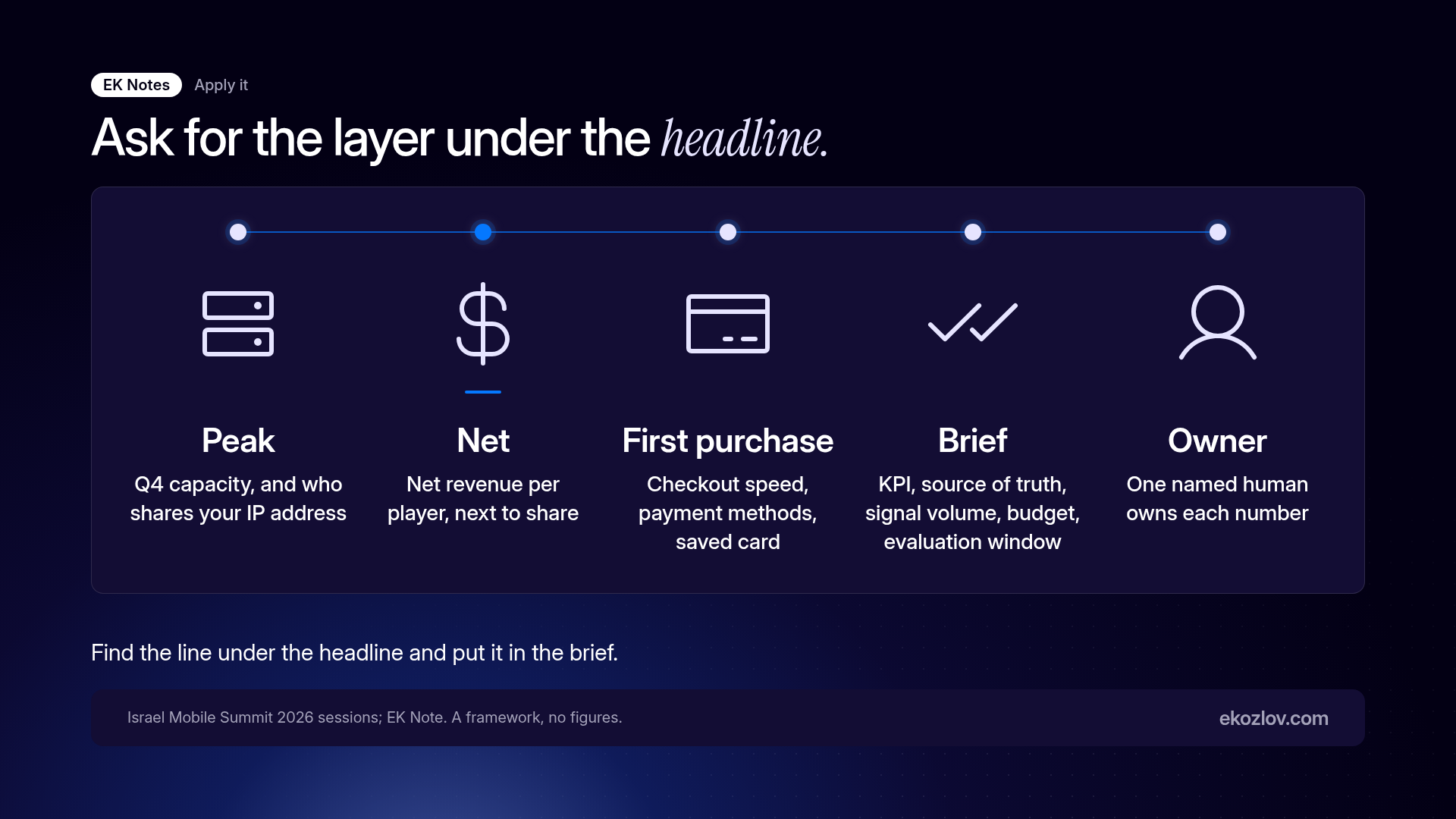
My notes from four sessions on 29 Oct 2026 at Expo Tel Aviv: "Every Request Counts: Building Resilient Ad-Ops in the Cloud"; "Game Economy Redefined"; "The New App Growth Playbook"; and the final minutes of a closing panel. All figures are speakers' claims.
Sources
- Israel Mobile Summit 2026, official site, read 30 Oct 2026 (session titles, speakers and roles.)
- Israel Mobile Summit 2026, agenda page, read 30 Oct 2026 (session titles, speakers and roles.)
Related notes
- The whole app chain in one dayIsrael Mobile Summit put infrastructure, payments, growth and measurement in one building. My notes on the day, the people and the sessions.
- Shopping season starts in SeptemberTikTok's research in Kazakhstan says most autumn and winter purchases happen outside the big sale days. A Q4 plan built around Black Friday now arrives late.
- Fund the list, not the boothIn 2027 event money should follow a named list of target accounts and the small rooms where you meet them. The booth earns its cost only where that list walks past it.