The human who checks the AI
- B2B marketing
- Lessons
- Feed economy

A buyer joins a call and reads out what ChatGPT told them about your product. Most of it is right. One line about pricing is two years old, and one integration on the list does not exist. The account executive now has ten minutes to do something no content calendar planned for: correct the answer and be believed.
A lot of B2B deals now turn on that moment. AI made information cheap. It did not make it cheap to find a person the buyer is willing to check that information against. I think that person, named and reachable, is now the most valuable content asset a B2B team has, and most of us are staffing for the opposite.
What the surveys say
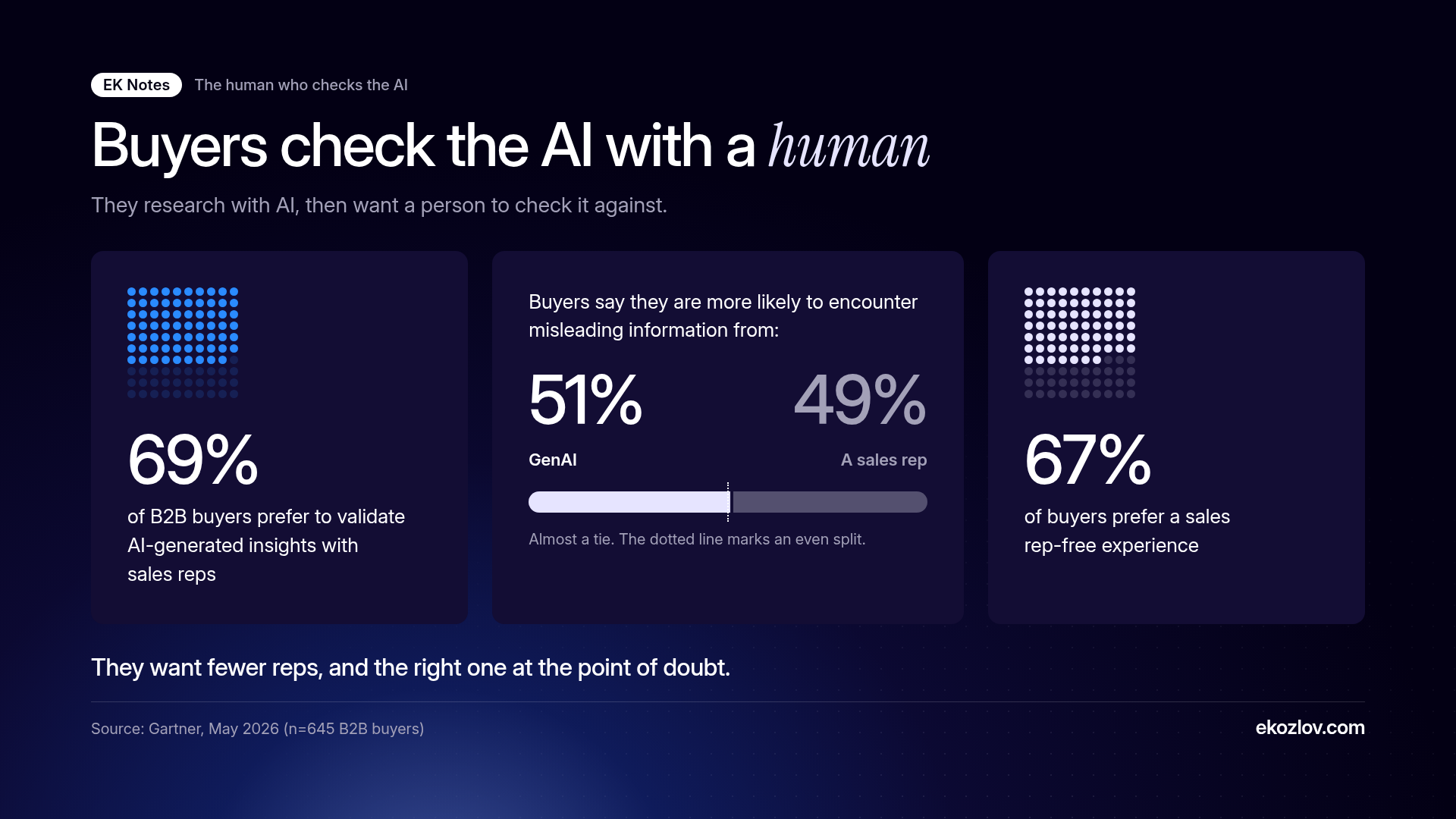
In May, Gartner reported that 69% of B2B buyers prefer to validate AI-generated insights with sales reps. The survey covered 645 buyers and was fielded in August and September 2025. Of those buyers, 45% had used GenAI in a recent purchase, mostly to gather information on vendors and products, and they used seven information sources on average. Trust is split almost evenly: 51% said they were more likely to meet misleading information from GenAI, and 49% said the same about a sales rep.
On 22 September, a second Gartner survey added a signal from the consumer side. Of 1,006 US consumers asked in May and June, 65% said brands produce too much AI-generated content, 57% said it made them trust brand messaging less, and 43% said they now rely more on real people for shopping information and recommendations.
That second set is consumer data, and I would not stretch it into a B2B finding. I read it as the direction of travel. The B2B number is the one with a buying committee behind it.
More output answers the wrong problem
The tempting response to AI-mediated buying is more content. More pages for answer engines, AI-avatar explainer videos, ghostwritten executive posts on a schedule. Volume costs almost nothing now, so it feels like the obvious lever.
The mechanism works against it. A buyer who already has an AI summary gets nothing they can trust from another generic page. And if buyers are almost as wary of a rep as of the chatbot, a rep reading from a script adds little. At the point of doubt, the buyer wants someone with a name and something to lose by being wrong. Content published under nobody's name cannot do that job, however much of it you ship.
There is a brake on this argument. The same May release says 67% of buyers prefer a rep-free experience and 70% prefer a fully digital, self-service one. So buyers are not asking for more people in the process. They want the right one when they doubt what they read. For routine, low-value purchases, self-serve should win and nobody needs a call. The validation moment matters most where the deal is large and the AI answer is likely to be partly wrong.
Staff for the check
Stage work at iFX EXPO and IMH taught me a version of this. A named person in front of a room is someone the room can test its assumptions against. Inside a company, that job falls to the account executive, usually without any preparation.
So this is the rule I would run next week. Ask your AEs for the three questions buyers bring to "check what the AI said". Give each one an answer from a named expert: a short clip or a written note, under a real name, with the date it was last checked. Then track how often sales reuses each answer in live deals. Reuse in real deals tells you more about this content than views do.
If the budget is fixed, move some of it from output to the people who answer. A product specialist who can join late-stage calls, or an engineer with two hours a week to record answers, covers more of a buyer's real doubt than another fifty pages.
The test I would apply is simple. When a buyer reads out an AI answer about you, does your team know who checks it, and does that person have something ready under their own name? If not, the AI is doing your positioning and nobody owns the correction.
Sources
More on the feed economy on stage: IMH·iFX EXPO.
Next in this series · B2B marketingThe favourite is picked before the formRelated notes
- Trust takes quartersWhy B2B marketing in long sales cycles is a trust problem first — and what that changes about how you show up in the feed.
- Brand loses the budget meeting in the wrong languageBrand budgets rarely lose on belief. They lose because the pitch never becomes a line in finance's pipeline model.
- Closed-lost is the seller's versionCRM loss codes are the seller's story of a buyer decision. Plan 2027 messaging on buyer interviews, not the dropdown.