Brand loses the budget meeting in the wrong language
- B2B marketing
- Lessons

In September 2009 Fly put the DS150 on sale: a cheap dual-SIM phone with a battery over 1,200 mAh. I carried it for about four days of heavy calls and texts before it needed a charge. Marketing filed it under "Xlife", a range name meant to signal long battery life. I wrote on my blog that week that I regretted the name, and that the ad about to go up around town was funny, but not everyone would get it. The buyer's fact was "four days on two SIMs". We handed them a word to decode.
I think about that phone every budget season, because brand teams make the same mistake with a different buyer. In the budget meeting the buyer is the CFO. The fact they need is what brand does to numbers they already track. What they get is "awareness", "salience" and "brand is a long-term game". That is Xlife: accurate inside the marketing team, and a word the person holding the money has to decode.
Brand budgets don't usually lose because finance is against brand. They lose because the pitch asks finance to believe, instead of showing brand as a line in the pipeline model.
What marketers wish would change
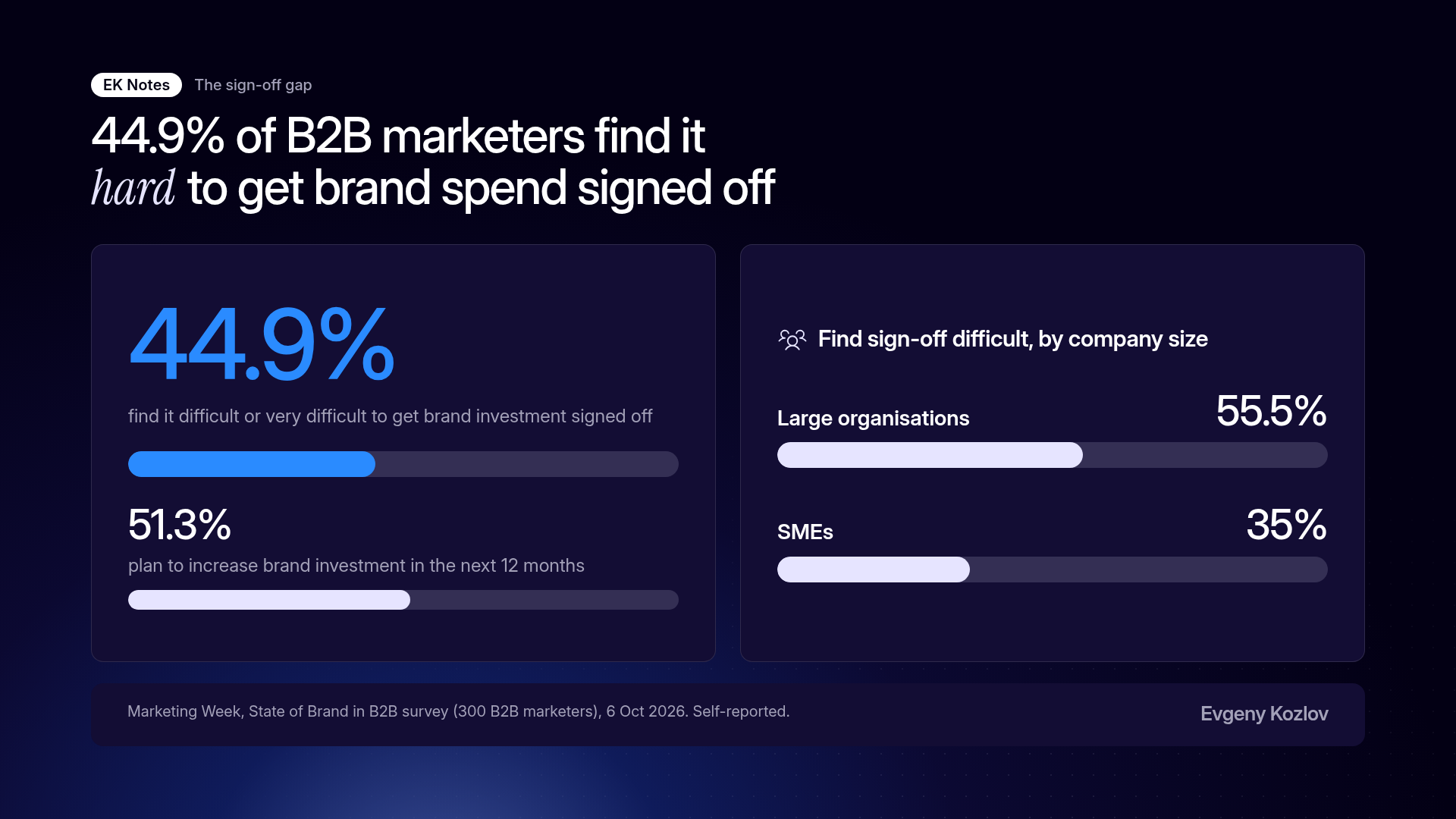
Marketing Week's State of Brand in B2B survey of 300 B2B marketers, published on 6 October 2026, puts the tension in two numbers. 51.3% plan to increase brand investment over the next 12 months. 44.9% find it difficult or very difficult to get that investment signed off. In large organisations the figure is 55.5%; in SMEs it is 35%.
A follow-up piece reports what respondents think would make it easier. 38.9% want a CEO and CFO who understand brand building better. 25.8% want leadership to be less focused on ROI.
Both answers wish for a different audience. The same survey suggests the audience isn't the main blocker. Asked why brand isn't a budget priority, 9% point at a CEO or MD who doesn't believe in brand building. Across the full sample, 40% say brand isn't seen as delivering ROI in their company, and 55.1% would like more robust effectiveness measurement. The problem is mostly not belief. It is translation.
Confirmed: every figure above is from the two Marketing Week articles in the sources. They are self-reported answers from one trade title's panel, and planned spend is not actual spend.
Before and after
Before: the brand deck. Awareness lift from a survey panel, share of voice, a slide saying brand works over years, and an ask that leadership trust the long term. Finance hears a cost with no line in the model, so it is the first thing cut when the quarter wobbles.
After: a one-page memo in finance's language, three lines long.
- The number finance already tracks. For example, win rate and sales cycle length in accounts that knew you before first contact, compared with accounts that didn't, or the share of pipeline that starts with direct and branded search demand. Pick two or three your CRM can actually produce.
- The brand input that should move it. A named programme, a fixed share of budget, the accounts or markets it covers.
- The review date and the cut. Two quarters from now you show the same numbers again. If they haven't moved, you have already named what you will stop funding.
The brand deck vs the budget memo
Operating argument from this note, not survey data.
Before: the brand deck
- Awareness lift
- Share of voice
- “Brand is long-term”
- Ask leadership to understand brand, or to be less ROI-focused
After: the memo
- A number finance tracks
- The brand input
- A review date and a stop rule

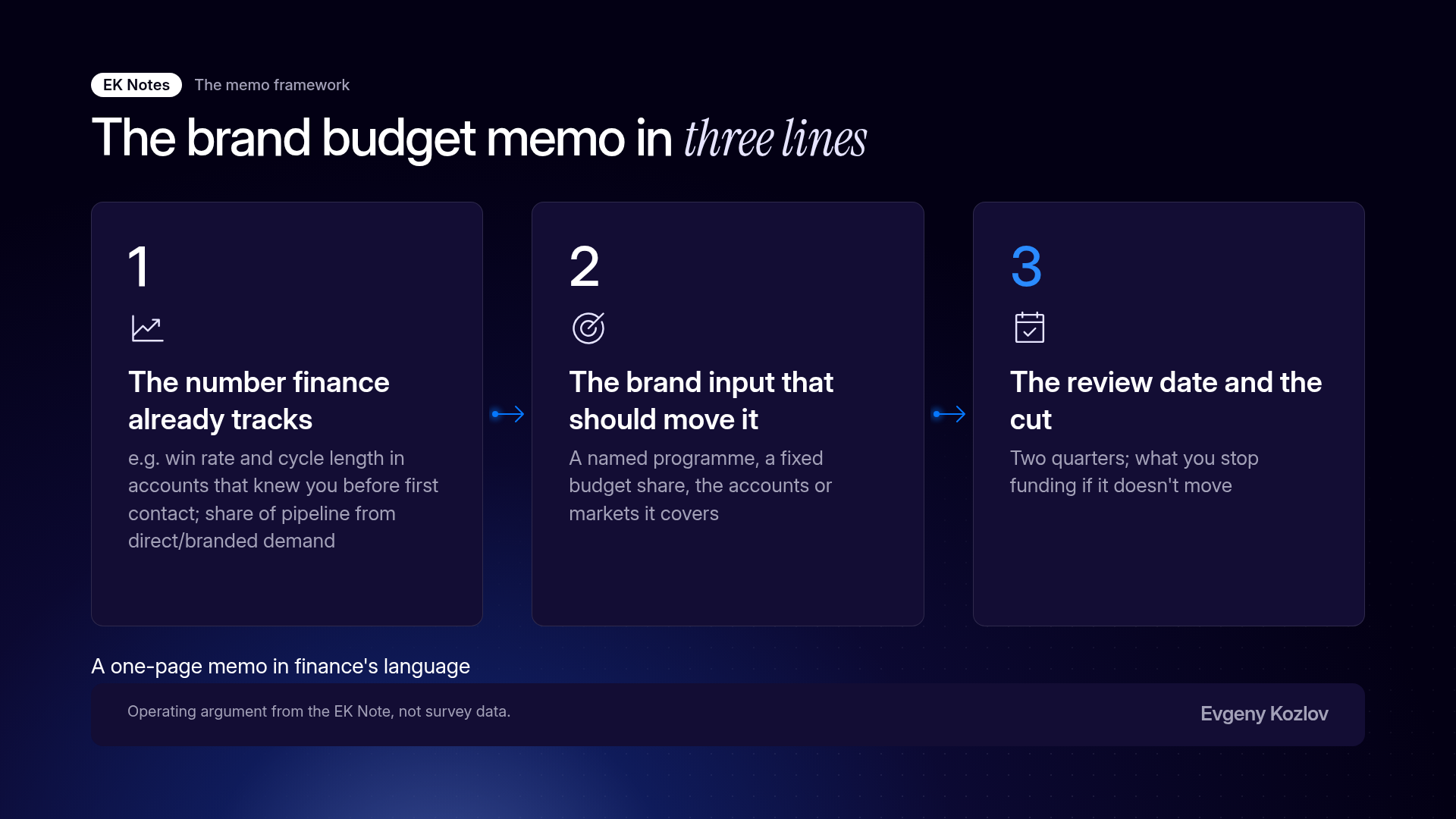
The third line does the work. Finance doesn't have to love brand. It has to see that brand has a test it can fail. A line with a review date and a stop rule looks like every other investment on the sheet, and that is the point.
Plausible, not proven: those metrics are my suggestion, not survey findings. Accounts that knew you before first contact will win more partly because they were warmer to begin with, so present the comparison as a direction to watch, not proof of cause. Saying that in the meeting buys more credibility than an inflated attribution number.
When the memo is the wrong tool
In a founder-led company the CEO's belief can be the whole budget decision, and a memo won't beat one good conversation. The survey hints at this: SME marketers struggle far less than those in large organisations (35% against 55.5%). The translation problem grows with the number of people between the marketer and the money. If your budget is approved in another country, by people who never see your market, you are in the large-company version of the problem even when your team is small. Many regional teams will recognise that setup.
The Xlife phone didn't need a cleverer name. It needed "four days on two SIMs" on the poster. A brand budget needs the same edit: say what it does to win rate and cycle length, put a date on the check, and let finance hold you to it.
Sources
- Marketing Week, "Most B2B businesses set to increase brand spend", 6 Oct 2026 (State of Brand in B2B survey, 300 B2B marketers) (51.3% plan to increase brand investment in the next 12 months; 44.9% find securing brand investment difficult or very difficult; 55.5% in large organisations vs 35% in SMEs.)
- Marketing Week, "Lack of CEO understanding harming B2B brand building push", Oct 2026 (same survey) (38.9% say a better CEO/CFO understanding of brand building would help; 25.8% want leadership less focused on ROI; 55.1% want more robust effectiveness measurement; 47.7% say brand is not a budget priority, and 9% cite a CEO/MD who doesn't believe in it; 40% say brand isn't seen as delivering ROI.)
- Evgeny Kozlov, "Fly DS150 - X- for my -Life", ekozlov.ru blog, 9 Sep 2009 (DS150 on sale that week; battery over 1,200 mAh; about four days of heavy use; regret at the Xlife range naming; ad "funny, but not clear to everyone".)
Related notes
- Closed-lost is the seller's versionCRM loss codes are the seller's story of a buyer decision. Plan 2027 messaging on buyer interviews, not the dropdown.
- Your AI SDR is a deliverability programAn outbound agent on a big list mostly spends your sender reputation. Replies come from small segments, checkable facts and a human edit.
- Satisfied is not safeSatisfied customers still review partners. Treat renewal as a marketing job, not a CSAT score.