Satisfied is not safe
- B2B marketing
- Lessons

A QBR slide shows CSAT green and NPS steady. Sales calls the account healthy. Finance books the renewal. Three months later the champion forwards a competitor's one-pager and asks for a bake-off.
I would send this note to sales, CS and finance before that meeting. Customers rarely leave because they are angry. They leave when someone else makes the business case easier to defend. Renewal is a marketing problem, and most marketing budgets stop at closed-won.
What the Carbon numbers show
In September 2026, Carbon published its B2B Buyer's Report 2026, a national proprietary survey of 189 quality-filtered B2B decision-makers. The headline looks comfortable: 94% of decision-makers are satisfied with their current partners. The next two lines are not. 59% expect to review or reconsider at least one partner in the next year. 54% have considered replacing a partner despite being generally satisfied with its performance.
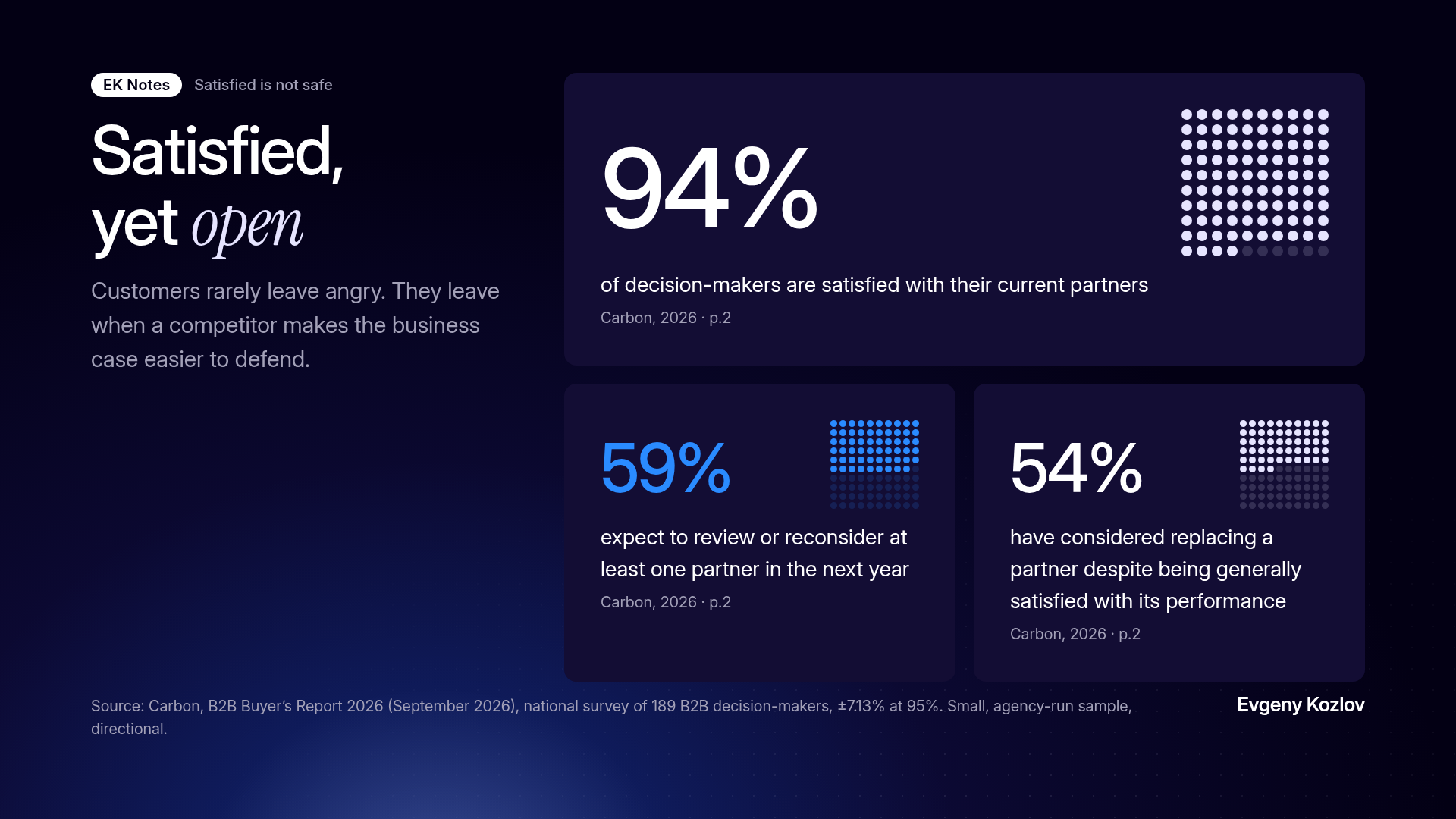
That is the gap CSAT and NPS miss. A satisfied score answers "how do you feel about us?" It does not answer "would you choose us again if a competitor walked in with a clearer case?" The review number is the one I would put next to every green health score. In partner and agency work especially, the competitor often wins on a page the champion can forward.
Some cautions before this goes into a deck. The sample is small and agency-run (±7.13% at 95% confidence). Carbon itself frames the findings as directional indicators, and the survey covers partners and service providers broadly, not only SaaS. I have no parallel numbers for Cyprus, Malta, Kazakhstan or Azerbaijan, so in the markets I work in this is a hypothesis to test against real renewals, not a law.
Why the dashboard lies
Most marketing plans still fund new logos as if retention is someone else's job. CS owns the ticket queue. Sales owns the renewal call. Marketing owns the next lead. The champion who has to defend the spend inside their company gets a case study from two years ago and a health score from last quarter. None of that is a forwardable argument for staying.
CSAT and NPS are useful as service signals. They are a weak retention forecast. A buyer can be generally satisfied and still open a review when a competitor makes cost, outcomes or next-year roadmap easier to explain upstairs. Q4 is when those reviews land for 2027 plans. Waiting until the renewal email goes out is late: the champion already needed something they could send without you on the call.
Satisfaction is not a forecast
EK framework: operator practice, not survey data. No figures.
Before
- CSAT and NPS read as a retention forecast
- The marketing budget ends at closed-won
After
- A would-choose-again signal
- A renewal case the champion can defend
Customers rarely leave angry. They leave when a competitor makes the business case easier to defend.

Data and text version
| Before | After |
|---|---|
| CSAT and NPS read as a retention forecast | A would-choose-again signal |
| The marketing budget ends at closed-won | A renewal case the champion can defend |
There is a brake on this. Where switching costs are high — deep integrations, regulated data, multi-year contracts with real exit pain — inertia really does protect the incumbent. The memo matters most for services and mid-ACV tools, where a forwardable page can change the room. If your product is wired into the customer's stack and leaving would take a year, keep the hygiene and still ask the choose-again question; do not pretend a one-pager alone will save you.
What I would change this week
Three changes look cheap enough to start now. (1) Sixty to ninety days before each key renewal, give the champion a one-page case for staying: outcomes delivered, cost versus alternatives, and what is coming next, written so they can forward it without you in the room. (2) At every account review, ask "would you choose us again today?" and treat a soft answer as renewal risk, not a CSAT footnote. (3) Put a renewal line in the marketing plan — even a thin one — so the budget does not end at closed-won.
Make the case for staying early
EK framework: operator practice, not survey data. No figures.
“Would you choose us again today?” Read the answer as renewal risk, not as satisfaction.
A forwardable one-page case for the champion: outcomes, cost, what’s coming.
The case the champion carries into the room you are not in.

Data and text version
- Ask the risk question (Every account review). “Would you choose us again today?” Read the answer as renewal risk, not as satisfaction.
- Send the case for staying (60 to 90 days before renewal). A forwardable one-page case for the champion: outcomes, cost, what’s coming.
- The champion defends it (Renewal). The case the champion carries into the room you are not in.
If your health dashboard cannot tell you which champions would re-buy today and which cannot defend the spend, it is measuring satisfaction. I would rather measure the case for staying.
Sources
More on the feed economy on stage: IMH·iFX EXPO.
Next in this series · B2B marketingYour AI SDR is a deliverability programRelated notes
- Brand loses the budget meeting in the wrong languageBrand budgets rarely lose on belief. They lose because the pitch never becomes a line in finance's pipeline model.
- Closed-lost is the seller's versionCRM loss codes are the seller's story of a buyer decision. Plan 2027 messaging on buyer interviews, not the dropdown.
- Your AI SDR is a deliverability programAn outbound agent on a big list mostly spends your sender reputation. Replies come from small segments, checkable facts and a human edit.